Exception Handling Design in End-to-End Administrative Automation
Why agents complete healthcare workflows where rule-based bots fail.
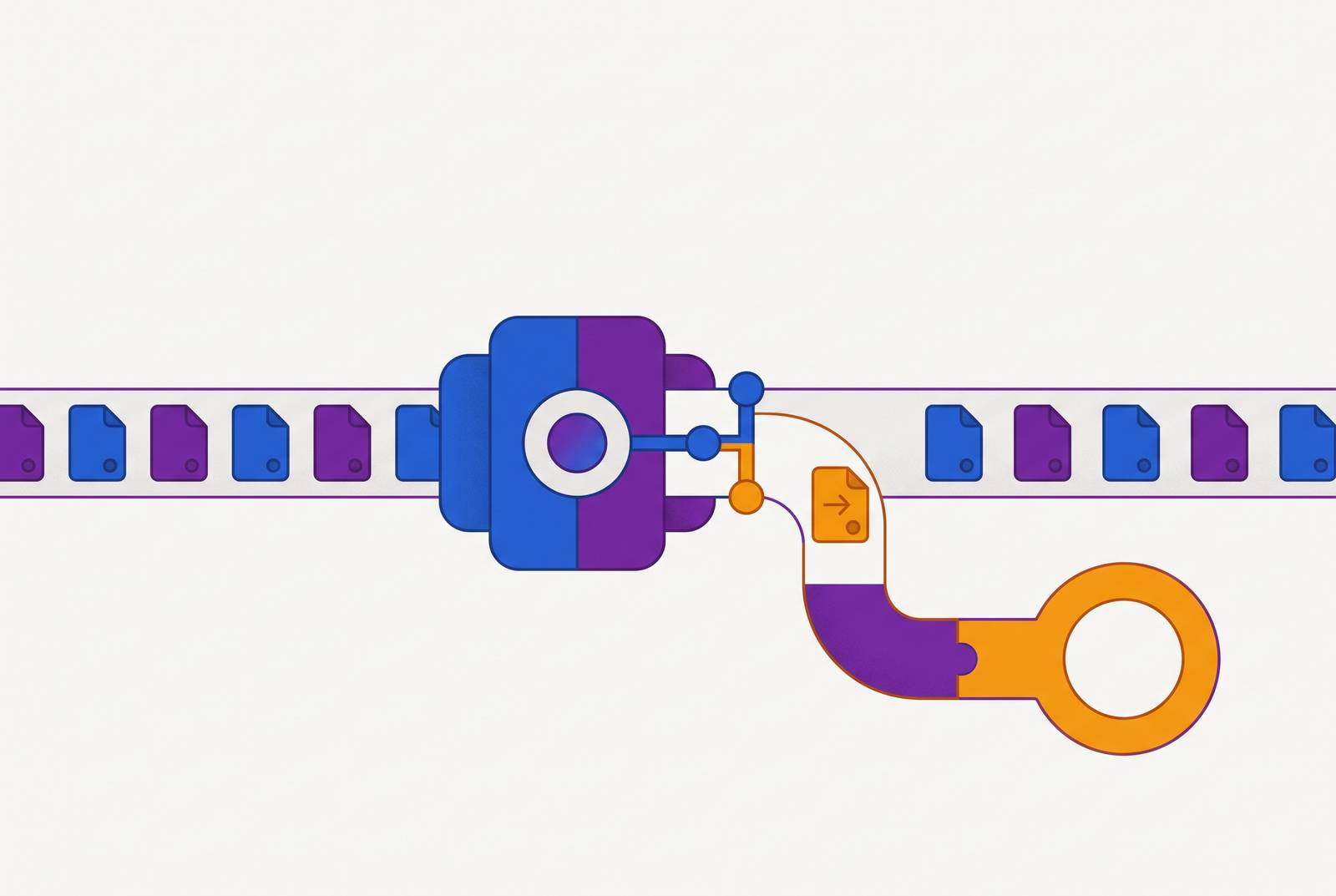
A payer portal changes a field label overnight. A denial letter can also arrive as a scanned PDF with no machine-readable text. Or maybe a form for prior authorization has a field the automation was never told to expect. In each case, a rules-based bot built on robotic process automation (RPA) does the same thing: it stops. End-to-end administrative automation does not fail on the routine step, where the screen sequence matches what the bot was scripted to see. It fails at the exception, and the failure is structural. The failure mode is binary: the bot completes the task exactly as written or it halts and hands the error to a human with no context about what went wrong or why. In healthcare administration, that departure from script is not an edge case. HealthAdminBench, a benchmark built by Stanford University, Kinetic Systems, and Stanford Health Care, confirms where this gap actually sits: agents fail to reliably complete end-to-end tasks specifically because of errors in document handling and cross-system data transfer, the two points where structured expectations collide with unstructured reality. The question that separates a task-starting automation from a task-completing agent is whether it was built to handle what happens after the script breaks.
What computer-use agents do differently when they encounter an exception
Computer-use agents interact with software the way a human staffer does: they read whatever is currently on the screen, rather than relying on a pre-mapped data field tied to a fixed schema. A computer-use agent, or CUA, perceives the graphical interface directly. It clicks, types, and navigates, and the underlying system does not need to expose an API or conform to a schema defined in advance. That distinction changes what even counts as an exception. That design matters because hundreds of payer portals have no formal API at all, so CUAs navigate them the way a human billing staffer would, including authentication flows that have historically defeated traditional automation. The shift is from replaying a fixed script to reasoning about the current state of the interface and deciding the next action. That capacity for in-context reasoning is what makes genuine exception handling possible instead of exception-stopping, but the capacity to adapt is not the same as a guarantee of reliability, and the benchmark data makes that tension explicit.
The gap between subtask competence and end-to-end workflow completion
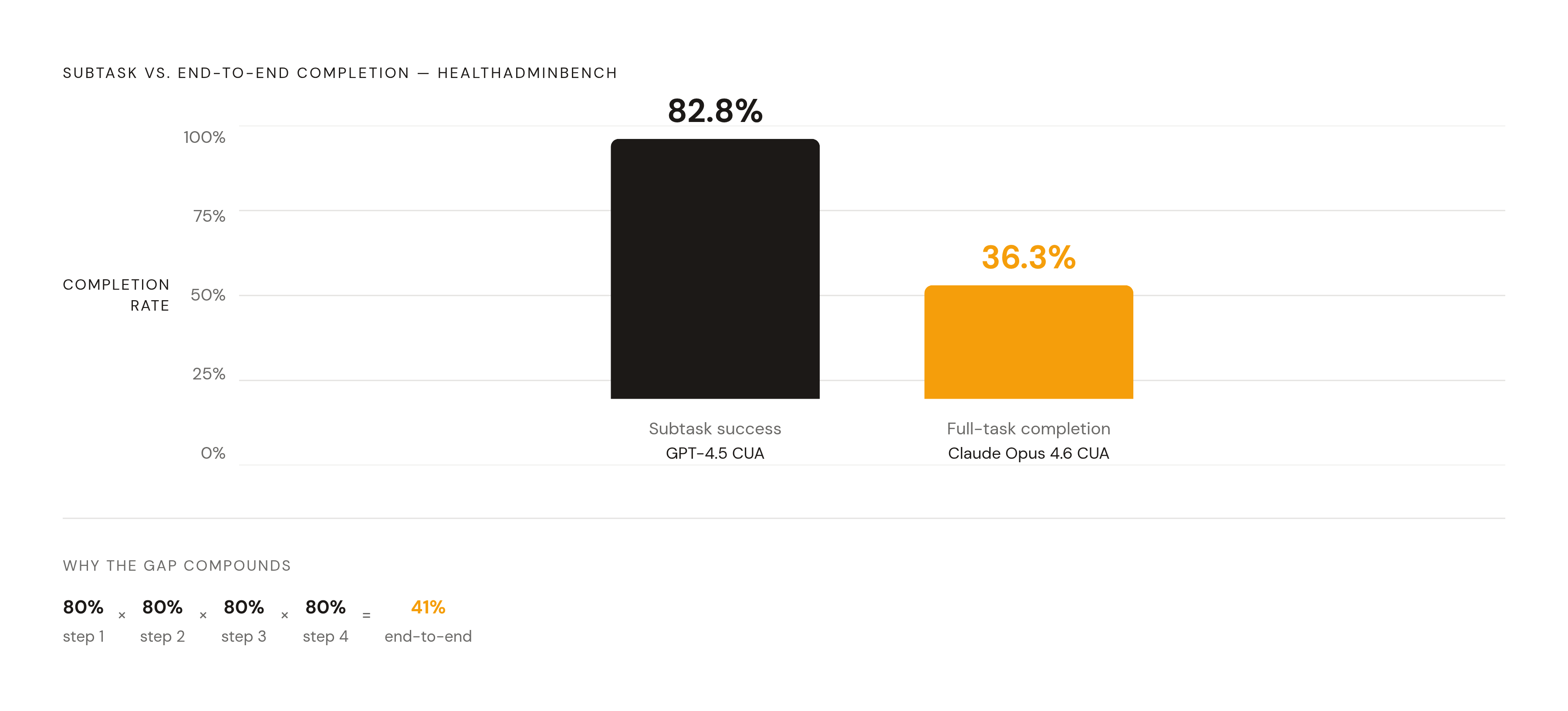
Agents that handle individual steps well can still fail complete workflows often enough that unsupervised deployment is risky today, and you can see in the pattern of those failures exactly where exception design needs to concentrate. HealthAdminBench found that despite strong subtask performance, with GPT-5.4 CUA achieving the highest subtask success rate at 82.8%, end-to-end task success remained far lower: the best-performing agent overall, Claude Opus 4.6 CUA, completed only 36.3% of full tasks across the benchmark's 135 expert-defined tasks. The gap between subtask success and full-task success is mainly a compounding problem: an error introduced at step three that goes undetected corrupts every subsequent step built on top of it, and cross-system data transfer, whether moving information from an EHR to a payer portal or from a fax into a structured form, is precisely where those errors concentrate. The practical implication for exception design is specific: an agent needs to detect when its own output at one step is wrong or ambiguous before committing that output to the next system downstream, not only detect when an external system returns an unexpected response. A natural objection follows: if subtask performance sits above 80%, why not simply chain enough reliable subtasks together to reach reliable end-to-end completion? Errors do not average out across a chain, they compound through it. If a sequence of steps each succeeds at 80%, the success rate drops dramatically as the chain lengthens, and healthcare administrative workflows routinely involve ten or more sequential cross-system actions before a task is done. The reliability gap documented here shows that a capable agent finishes what it starts only when the architecture built around exception handling supports it.
The four exception types that break administrative workflows most often
Administrative exceptions cluster into four distinct failure patterns, and each one demands a different design response; treating them as a single undifferentiated category produces systems that handle none of them well. The first is the interface exception: a payer portal changes a field, adds a CAPTCHA, restructures a form layout, or times out mid-session, leaving the agent unable to locate an expected element or facing a screen state it has never encountered. HealthAdminBench identifies document handling as one of the primary sites where end-to-end task completion breaks down: the agent has to extract structured data from unstructured input before it can act on it, so any misextraction at that stage corrupts every step that follows. The third is the cross-system data transfer exception: information read correctly from the EHR does not match the field schema the payer portal expects, or a code valid in one system is invalid, or simply formatted differently, in another. The fourth is the decision-point exception: the workflow reaches a branch where the correct next action depends on clinical or payer-specific judgment the agent cannot resolve on its own, such as a denial reason requiring a human assessment of medical necessity, or a payer rule that conflicts with the referring physician's documentation. Escalation to a human at this point is not a failure of the system, it is the correct designed behavior. The actual failure occurs when the agent escalates without useful context, or worse, when it makes a decision in that moment that should have been left to a person.
Exception Handling Routes Each Failure Type Without Stopping the Workflow
What separates an agent that completes workflows from one that merely starts them is a deliberate exception architecture that matches each of the four failure types to a specific, designed response. For interface exceptions, the agent should try adaptive navigation before it escalates: it reads the current screen state to find a functionally equivalent element instead of stopping the moment a familiar label is missing, and timeouts and multi-factor authentication challenges belong inside the agent's session management layer, handled as normal operation instead of terminal failures that need a human to restart the task. For cross-system data transfer exceptions, you need field-mapping validation between systems to be a discrete step in the agent's process, not an assumption baked silently into the handoff. The agent checks that a value extracted from the EHR falls within the format and value range the target payer portal expects before it submits anything, so if there's a mismatch, you get a correction step instead of an outright failure further down the line. For decision-point exceptions, the agent should escalate with full context: the state of the workflow at the moment of escalation, the specific question that requires human judgment, and the information already gathered, so the human reviewer can act immediately instead of reconstructing what the agent already did. Across all four exception types, the governing design principle stays the same: keep the workflow moving, either by resolving the exception autonomously or by handing it to a human with enough context to resolve it in a single step.
Exception Design in Real Deployments: Successes and Ongoing Struggles
When organizations deploy agentic automation against high-exception administrative workflows, you see measurable gains specifically where exception handling was built into the design from the outset, and you see persistent gaps where it was not. MUSC Health expanded its agentic AI deployment for prior authorizations, and it now completes a meaningful share of them with zero manual involvement, so approval times have dropped from roughly 30 minutes down to about one minute. The residual gap is equally real and needs to be stated alongside the wins. Human oversight of the escalation queue is a necessary design element of any serious deployment today; it is not a temporary workaround awaiting a better model. What "solved" would actually require is an end-to-end success rate that approaches the reliability of a trained human staffer across the full range of exception types a workflow produces, not just strong performance on the individual subtasks that make up the chain.
How CMS-0057-F and new interoperability requirements change the exception landscape for prior authorization
The CMS 2026 Prior Authorization Rule, known as CMS-0057-F, tightens both the timelines and the specificity requirements that define what a successful prior authorization workflow has to accomplish, making fast, precise exception handling a regulatory requirement. The rule's requirement for specific denial reasons changes how exceptions must be designed: agents appealing a denial now have structured, machine-readable denial rationale to work from instead of vague boilerplate language, which makes automated appeals handling considerably more tractable as a document-handling exception. That same specificity requirement means the agent has to correctly parse and act on a much wider variety of distinct denial codes, and each one can route to a different next action. The compressed response timelines the rule establishes mean that exceptions which stall a workflow, whether an ambiguous document, a field mismatch, or a portal timeout, now carry a direct regulatory cost whenever they push a submission past the payer's required response window. The WISeR Model, a six-year CMS pilot running from 2026 through 2031 across Arizona, New Jersey, Ohio, Oklahoma, Texas, and Washington, applies AI-assisted prior authorization to 14 elective Part A and Part B services within traditional Medicare. That pilot signals that regulators see AI-assisted prior authorization as a viable, scalable approach at the program level, and not just a workaround confined to private payer contracts.
HIPAA compliance must be designed into the exception path, not just the routine path
Exception handling is where HIPAA compliance is most likely to break down, because exceptions generate the unscripted agent behavior, the unexpected data read, the escalation log, the cross-system transfer, that falls outside whatever compliance architecture was built around the routine workflow path. AI agents accessing protected health information are subject to HIPAA just as any human employee or business associate handling that data would be. The Privacy Rule, the Security Rule, and the Breach Notification Rule govern the data itself, not who or what is reading it, so an agent's exception-path behavior sits under the same obligations as its routine-path behavior. Prior authorization is among the most PHI-dense workflows an agent can touch, requiring diagnosis codes, treatment history, and payer-specific medical necessity criteria simultaneously, and the exception path for a failed PA submission may require the agent to read additional clinical fields in order to support an appeal. Every one of those additional reads has to appear in the audit trail. A HIPAA-compliant exception architecture requires a signed Business Associate Agreement with every vendor that touches PHI anywhere in the exception path, including model hosts and any logging or observability tools sitting underneath the agent, along with PHI encryption at rest and in transit, role-based access control enforced at the system layer, and immutable audit trails covering every decision the agent makes, including decisions made during exception handling and not only its routine completions. State-level disclosure requirements add another layer to account for. Utah's AI disclosure law, in force since May 7, 2025, requires upfront disclosure of AI use in high-risk interactions within regulated occupations, with reactive disclosure available upon consumer request in other consumer transactions, and it carries per-violation penalties for noncompliance. Practices operating in covered states need to include their exception routing and escalation workflows in their disclosure posture from the start, not just the patient-facing automation that is easiest to document.
What to evaluate in an agent's exception handling before committing to a deployment
If you are evaluating administrative automation, test exception handling directly, and don't accept routine-path performance as evidence that an agent will hold up once the work gets hard. Most vendor demonstrations show the happy path: the prior authorization that clears on the first submission, the claim where every field matches cleanly. A serious evaluation introduces the exception types that actually matter, deliberately: a payer portal with a changed layout, a denial letter delivered as a PDF, a cross-system field mismatch, a workflow that reaches a genuine decision point requiring human judgment. Escalation quality matters as much as escalation rate. An agent that escalates frequently but hands off rich context, including the workflow state, the specific question at hand, and the information already gathered, is more valuable than one that escalates rarely but produces only a generic error code when it does. If a vendor cannot show you what the agent did when something went wrong, it has not built exception handling; it has built exception hiding. On performance, HealthAdminBench shows that subtask success rates run consistently far higher than full-task success rates, so ask vendors for end-to-end completion rates on the specific workflows that need automating, and don't accept component-level accuracy as a stand-in. Computer-use agents that operate at the GUI layer, navigating EHRs, payer portals, and third-party systems the way a human staffer would, handle interface exceptions without requiring the underlying system to be rebuilt first, and a deployment that goes live in weeks lets exception behavior be observed and refined in the actual production environment. Finally, agree on workflow-specific KPIs before deployment begins. The right measure of exception handling is not a universal completion rate, it is whether the agent performs the specific workflows a given practice runs, including that practice's own exception patterns, at the level a trained staff member would, with those KPIs set against the actual bottleneck the practice is trying to solve.