Prior Authorization Automation Vendor Comparison Criteria
Six criteria predict whether automation actually reduces staff hours or just shifts paperwork.

Prior authorization now costs the average physician roughly 13 hours a week and 39 requests, and 94% of doctors say the process contributes to burnout, the AMA's 2025 survey found. That volume is why vendor selection has become a real strategic decision rather than a line-item purchase: get the architecture wrong and a practice locks itself into months of integration delay while denials keep piling up at the front desk. This piece lays out what the current regulatory calendar demands, how vendors differ underneath the marketing language, and which six criteria actually predict whether a deployment reduces staff hours or just moves the paperwork somewhere else.
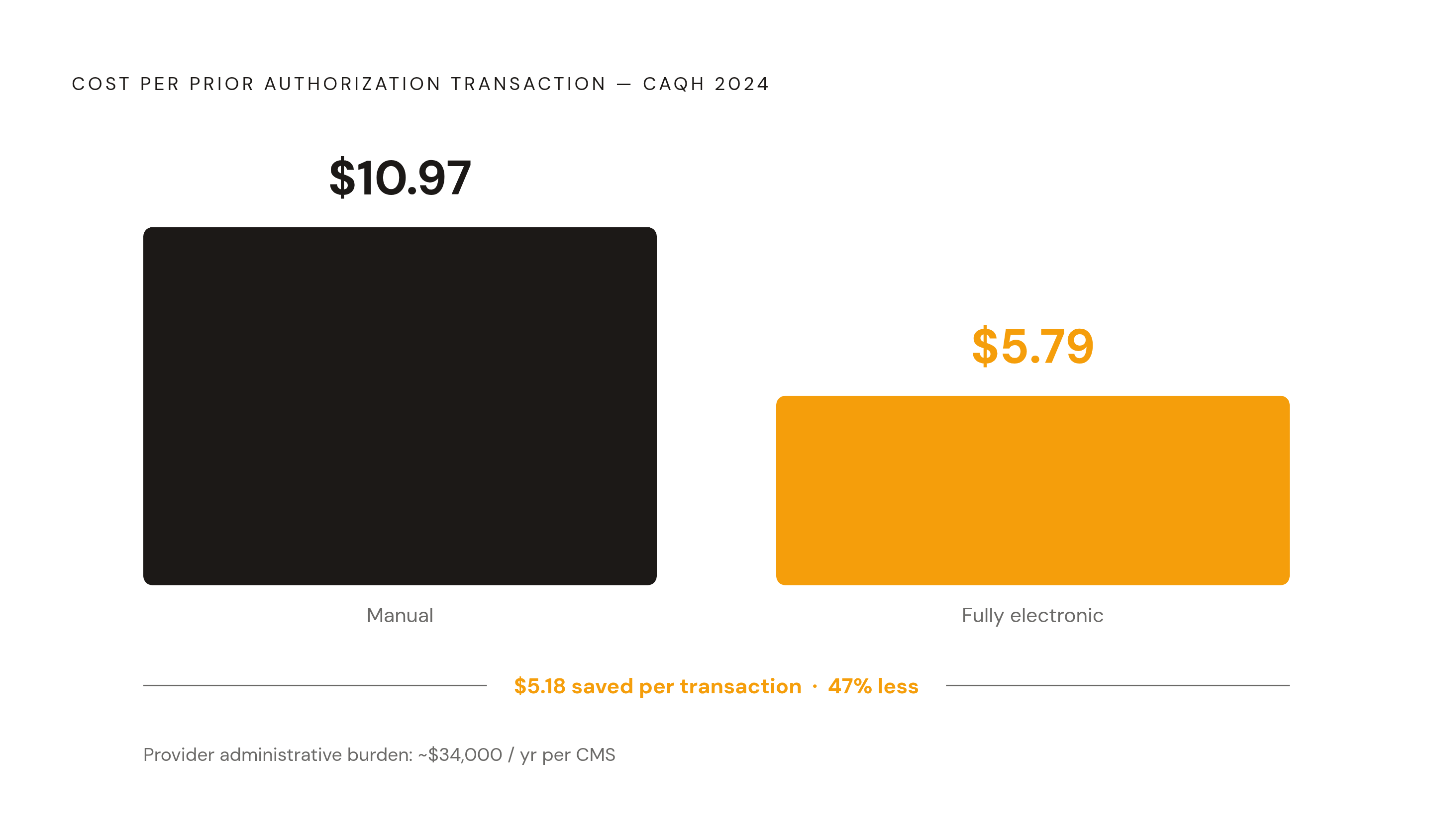
The stakes go beyond convenience. CAQH's 2024 Index put the cost of a manual PA transaction at $10.97, versus $5.79 when it's handled electronically start to finish, and CMS estimates the annual administrative cost per provider at $34,000. Administration eats up around a quarter of total healthcare spending in the country. Administration eats up around a quarter of total healthcare spending in the country, with inefficiency in that layer generating something like $13 billion in waste every year. None of this is a rounding error. It's a structural drag on revenue, staff retention, and, indirectly, how fast patients get care.
What the regulatory moment means for vendor selection
CMS-0057-F, the Interoperability and Prior Authorization Final Rule published in February 2024, gives regulated health plans a hard deadline: four production FHIR APIs live by January 1, 2027. CMS projects the rule will save the health system about $15 billion over ten years, but the more immediate effects are already visible on the ground.
As of 2026, payers must decide on urgent requests within 72 hours and standard requests within 7 calendar days. Denial reasons have to be specific enough to support an appeal. Payers are also required to publish their approval rates and decision-time metrics publicly. For the first time, practices can benchmark a payer's behavior instead of guessing at it.
The bigger shift is in January 2027, when four FHIR R4 APIs become mandatory: the Prior Authorization API (built on the Da Vinci PAS implementation guide, using the Claim resource and a $submit operation, with real-time responses required for most request types), the Document Requirement Lookup service (Da Vinci CRD, a CDS Hooks integration inside the EHR that tells a provider what documentation a payer wants before anything gets submitted), and Documentation Templates and Rules (Da Vinci DTR, FHIR Questionnaire resources that spell out what the payer needs, filled out inside the EHR itself). All four run on HL7 FHIR Release 4.
In mid-2025, 48 major health insurers voluntarily committed to simplifying PA starting in 2026, with a target of at least 80% real-time electronic approvals by 2027. Separately, CMS introduced the WISeR program (effective January 2026), which requires prior authorization for select fee-for-service Medicare services across six states: Arizona, New Jersey, Ohio, Oklahoma, Texas, and Washington. CMS is partnering with payers to test AI-assisted PA review under that program, and it signals where federal appetite for automated review is heading next.
None of this is background noise for a buyer. Any vendor that can't show a real path to FHIR R4 compliance by January 2027 is a regulatory liability wearing a vendor badge. FHIR-readiness isn't a nice-to-have feature to compare, it's a pass/fail screen that should happen before a practice looks at anything else. Practices still running on older workflows are already seeing denied PAs, failed care transitions, and friction at check-in, and that gap only widens as the deadline approaches.
The three architectural categories vendors fall into
The PA vendor market isn't one category with different logos slapped on similar software. It splits into architectures that determine, structurally, what a tool can and cannot automate, and comparing features across categories without understanding this first is close to useless.
Clearinghouse and revenue cycle management platforms treat PA as one module inside a much larger financial operations suite. Payer connectivity, not PA logic specifically, is the core asset these platforms sell. This model fits practices where PA is genuinely one small piece of a bigger RCM headache and where the practice already lives inside that vendor's ecosystem for billing and claims. The tradeoff: PA automation is rarely where these platforms innovate first, since their engineering priorities sit elsewhere in the revenue cycle.
Clinical intelligence and specialty PA platforms take a different approach. These tools embed actual clinical reasoning into the workflow: AI reads unstructured clinical notes, matches them against payer-specific medical necessity criteria, and assembles the supporting documentation before anything gets submitted. Availity's AuthAI, for example, positions itself as a transparent, auditable recommendation engine rather than an auto-deny system, generating recommendations in under 90 seconds and grounding them in codified medical policy rather than pattern-matching against historical outcomes. Insight Health is designed to score documentation against payer criteria before submission, with specialty coverage across a range of clinical areas. Innovaccer folds PA into a broader data activation and population health strategy; its 2025 AI Trends in Healthcare report found 52.38% of respondents named administrative tasks as the area most ready for AI impact, ahead of EHR management at 47.61%. These platforms earn their keep in specialty-heavy practices, where documentation quality and criteria-matching are what actually drive denial rates up or down.
Browser-native and computer-use AI agent platforms solve a different problem. Instead of relying on an API connection, these agents log into payer portals directly, navigate multi-factor authentication and CAPTCHA challenges, fill out forms, submit requests, and track status the same way a staff member would, just faster and at scale. This matters because a mid-size health system can interface with anywhere from 50 to 200 different payer portals, each with its own login flow and data format, and traditional API integration typically only reaches the handful of largest payers, leaving most of the actual volume untouched. One scaling organization using browser-native agents now runs more than 3,000 claim status checks a day, work that previously needed several full-time coordinators just to keep pace. The structural advantage here is that these agents don't require a payer to build or expose an API at all; they work with whatever exists today. That makes them a strong fit for practices with a broad, regional payer mix, or for practices where integration timelines with a traditional vendor have already stalled out.
A fourth category exists specifically for pharmacy PA. CoverMyMeds is the de facto standard here, having processed more than 43 million pharmacy prior authorizations in the first quarter of 2025 alone. That scale is a real network advantage for pharmacy-heavy practices, but it doesn't extend to medical or procedural PA. Practices need a separate, purpose-built tool for that side of the business; conflating the two is a common and costly mistake.
Comparing a clearinghouse platform's feature list against a browser-native agent's feature list is comparing two different tools built to solve two different problems. Figure out which architecture matches the payer mix, the EHR environment, and the specific workflow gap before opening a single feature comparison spreadsheet.
The six evaluation criteria that predict outcomes
System reach and payer coverage depth is the number that matters, not the vendor's total network size, but what percentage of a practice's actual payer mix gets covered, including the long tail of regional plans and Medicaid managed care organizations that never bothered building an API. API-based vendors tend to cover the top national payers well; browser-native agents cover every portal a staff member could physically log into, regardless of how technically mature that payer's systems are.
Workflow completeness, from determination through appeal. A genuinely automated platform has to handle four distinct stages: determination (does this specific service, for this specific plan, actually require PA?), documentation assembly (pulling structured clinical evidence out of the EHR), submission (portal, FHIR API, fax, or even voice), and status tracking with write-back into the chart. Plenty of tools automate one or two of these stages and market the whole thing as "automated PA," so buyers need to map each vendor explicitly against all four. Denial handling deserves particular scrutiny: does the tool classify the denial reason and either draft an appeal or route it to a human, or does it stop cold at submission and dump the denial back on staff? R1's Prior Authorization product reportedly clears 68% of orders within an hour and nearly 97% within a day, with auth-related denial rates under 1%, which is a useful number to hold vendor claims up against during a demo.
Clinical intelligence and documentation quality upstream. The most capable platforms don't just submit whatever documentation happens to exist in the chart, they shape it before submission: prompting structured capture at the right point in the visit, catching ICD-10 coding errors, flagging gaps before the request ever leaves the building. That's the actual difference between a tool that raises first-pass approval rates and one that just moves paperwork faster. Multi-agent systems built around confidence thresholds handle this well: when the AI's confidence in a clinical extraction drops below a set bar, the case routes to a human reviewer, so automation absorbs the high-confidence volume and staff time gets reserved for the genuinely ambiguous cases.
EHR integration approach and workflow disruption. Two models exist here, and they behave very differently in a multi-location group. Native EHR integration moves authorization data in and out of the clinical system without duplicate entry, but only works if the practice's specific EHR happens to sit on the vendor's supported list, so that needs verifying explicitly before shortlisting anyone. Browser-native agents sidestep that requirement entirely, operating across whatever systems staff already use and needing nothing more than a login, which compresses go-live timelines from months down to weeks. For a group running five EHRs across ten locations, a platform that requires per-EHR integration multiplies delay with every new site; agents working at the UI layer cover the whole portfolio without any additional integration work.
FHIR R4 readiness and regulatory compliance posture. Any vendor without a demonstrated path toward Da Vinci PAS, CRD, and DTR compliance by January 2027 is a liability, not a growth partner. Buyers should ask for an actual roadmap, not a reassuring commitment, and should ask which specific payers the vendor is live with today on FHIR-based submission, not which payers appear on a future integration list. HIPAA compliance and SOC 2 Type II certification are baseline expectations at this point, not differentiators, but their absence should disqualify a vendor immediately.
Deployment speed and the pilot-to-production track record. A 2025 Gartner analysis found that roughly 75% of healthcare AI pilots never make it to production, meaning only about a quarter progress past the pilot stage into full deployment. That's the majority of enterprise AI spend stalling out before it generates a dollar of value, so deployment history matters as much as feature depth. What's the median time from signed contract to first live workflow? What does implementation actually require from internal IT? What triggers escalation to a human? Medsender reports activation times around 15 minutes, an outlier that matters if a practice has been burned before by a six-month implementation that never quite finished.
How to map these criteria to your practice's bottleneck
There's no universal best vendor here. The right choice depends entirely on where the practice's specific bottleneck sits, and three profiles cover most of the field.
A high-denial-rate, specialty-heavy practice should weight clinical intelligence and upstream documentation quality above everything else on this list. Platforms built around specialty-specific payer criteria and pre-submission documentation scoring are the highest-leverage lever available to that kind of practice, because denials in specialty care usually trace back to a documentation gap, not a process failure.
A multi-location group or another type of investor-backed portfolio of practices with mixed EHR environments faces a different problem entirely: workflow completeness and deployment speed dominate. A platform requiring native integration for every EHR in the portfolio multiplies the implementation timeline with each new site added, while agents operating at the UI layer can cover the full portfolio from a single deployment, sidestepping that multiplication problem.
Pharmacy-heavy practices should keep CoverMyMeds for Rx PA, given its scale (43 million-plus authorizations processed in Q1 2025 alone) and its no-cost model for providers, but need a separate tool for medical and procedural PA. Treating the two as interchangeable is where a lot of practices waste budget on redundant coverage.
One useful gut check before any vendor conversation: manually processing a single PA request can consume up to 24 minutes of staff time. Multiplying that by weekly request volume and current headcount makes the addressable labor cost obvious fairly quickly, often more obvious than any vendor's ROI slide.
A handful of questions belong in every demo, regardless of category. What happens when a payer changes its portal layout overnight, and how fast does the tool adapt? What's the escalation path when the AI can't complete a request, and who actually gets notified? What KPIs get tracked post-deployment, and what does reporting look like at 30, 60, and 90 days out? And, critically: which of this specific practice's payers is the vendor live with today on FHIR-based submission, not which payers sit on a roadmap slide.
ROI, in the end, should get measured against KPIs agreed on before the contract is signed, denial rate, first-pass approval rate, staff hours per authorization, days to decision, not against a vendor's generic case study from a practice with a completely different payer mix and a completely different bottleneck.