Subprocessor and Third-Party Risk in Healthcare AI Vendor Stacks
Practices remain liable for AI vendor breaches even when subprocessors hide the risk.
A practice that signs a business associate agreement with an AI vendor has not finished its compliance work. It has started it. The risk in a modern AI deployment does not sit only with the company whose logo is on the contract; it sits with every subprocessor that company depends on to actually run the product, and most practice administrators never see that list. By spring 2026, almost every clinic, medical group, and health system in the country has at least one AI tool already touching protected health information, and in many cases the compliance officer has no idea it's happening. The scale involved is new: a single AI deployment can touch more PHI in a week than a legacy clinical system touched in a year, and the paths that data travels look nothing like the familiar "EHR to biller to claim" route that compliance programs were built around. None of this changes who answers for a breach. The BAA can shift financial liability to a vendor, but it cannot move regulatory responsibility off the covered entity's desk, so if a subprocessor three layers deep fails to protect PHI, the breach is still the practice's to report.
Multi-Layer AI Vendor Stacks and Data-Flow Paths
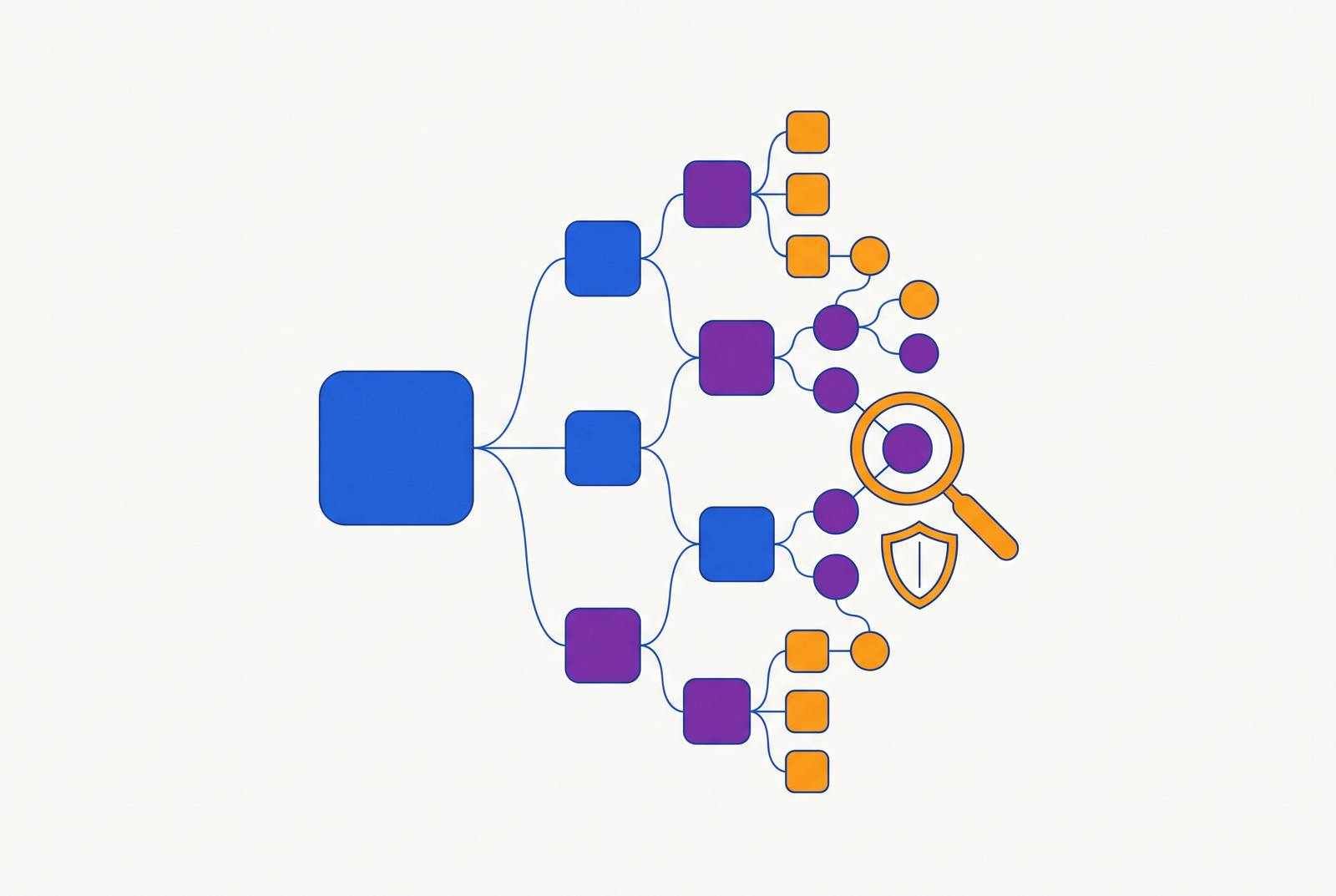
An AI product you buy today is rarely a single piece of software. It's a stack: cloud infrastructure underneath, third-party compute alongside it, an inference API doing the actual model work, and a set of workflow tools stitching the pieces together, any one of which can touch PHI without ever appearing in the contract a practice signs. Picture how an AI agent actually operates inside a payer portal. It reads what's on the screen, decides what to do next, calls whatever tool it needs to take that step, checks whether the action worked, and starts the loop again, which is what lets it move across an entire administrative workflow rather than sitting boxed inside one application window. That loop is also how the chain extends past the vendor a practice thought it hired: the product runs on cloud infrastructure that belongs to someone else, compute that belongs to someone else again, and sometimes an inference API from a fourth company. Every one of those parties, once it touches PHI, becomes a business associate in its own right, and the obligation to get a signed agreement from each of them falls on the primary vendor, not automatically on the practice. This problem is most visible in computer-use agents built to work inside payer portals. To do their job, these agents have to capture what's on screen, send it somewhere for processing, and log it, and that screen content carries member-level clinical and insurance data. The company that actually does that capturing is usually a subprocessor, and it never gets named in the BAA the practice signed.
The arrangement is also not fixed once it's running. Vendors add features, swap models, or bring on new partners after the contract is signed, and those changes can shift how PHI moves through the stack without procurement ever being told. Shadow IT makes the same problem worse from the inside: when departments bring in their own AI tools without routing them through a formal review, the practice accumulates dependencies nobody mapped. The procurement process that was supposed to catch this kind of exposure finds nothing to review.
HIPAA's structural gap for AI subprocessor chains
No federal agency has written HIPAA rules built specifically for AI. The Security Rule, the Breach Notification Rule, and the Privacy Rule are the same rules they always were, but now they're being stretched to cover a generation of vendor architectures that didn't exist when they were drafted. HIPAA compliant" is a phrase a vendor applies to itself, not a status HHS confers. No software gets certified as HIPAA compliant by the federal government. Whether a given platform is actually compliant depends entirely on how it's configured and used by the practice running it, and a label on a sales page says nothing about that.
The contracts practices already have tend to reflect this gap directly. Most standard BAAs were written before generative AI was a procurement category, so they're silent on questions that now matter most: whether a vendor can use PHI to train or fine-tune a model, and what happens once that data is handed off to a subprocessor. HHS has at least started to notice the shape of the problem. A 2025 proposed update to the Security Rule would require covered entities to keep a written inventory of every technology asset, AI systems included, that creates, receives, maintains, or transmits electronic PHI. Until that rule is finalized, contract language has to close the gap, not regulation.
The enforcement record shows HHS is already willing to act on weak vendor oversight using the tools it has now. The settlement with MMG Fusion, affecting 15 million individuals, rested on OCR's findings that the company failed to conduct an adequate risk analysis (the lead violation under OCR's Risk Analysis Initiative), impermissibly disclosed PHI, and failed to notify the covered entities whose data had been breached. That case didn't require a new AI-specific rule to bring. It used the same risk-analysis and notification obligations that have existed for years, and applied them to a business associate that didn't meet them. A broader pattern backs this up: a review of U.S. healthcare ransomware incidents found that roughly a third of provider-reported incidents between 2016 and 2024 involved a business associate, a pattern a 2025 peer-reviewed study calls a hub-and-spoke risk model, where one vendor's failure radiates out to every provider connected to it.
Prior authorization automation and concentrated subprocessor risk
Prior authorization is where this risk concentrates hardest, because the workflow forces an AI agent to touch EHR data, a live payer portal session, and an external decisioning API all within the same task, and the deadline to automate that workflow is no longer optional. CMS-0057-F took operational effect on January 1, 2026, and it requires impacted payers, Medicare Advantage, Medicaid and CHIP fee-for-service, and managed care plans (plus Federally-Facilitated Exchange QHPs, though only for denial-reason, public reporting, and API requirements; FFE QHPs are excluded from the decision-timeframe rules) to decide standard prior authorization requests within 7 calendar days and expedited requests within 72 hours, with a specific reason attached to every denial. FHIR-based electronic PA APIs come next, mandated for January 1, 2027, and that second deadline is what forces automation spending throughout the entire vendor stack, multiplying subprocessor exposure for payers and providers alike.
Where a payer still lacks a modern API, the automation has to get creative: AI agents place phone calls, navigate automated phone menus, and talk to live representatives to get an authorization through. Each of those steps routes screen-captured PHI through subprocessors whose data-handling terms rarely get read by anyone at the practice. Referral automation carries a nearly identical exposure. A faxed referral has to be parsed, matched against provider availability, checked against insurance, and booked, and each piece of that chain, the voice AI, the language model, the FHIR bridge, the write-back into the EHR, can be a separate subprocessor running under its own terms.
None of this pressure is coming only from the regulatory calendar. Between 2024 and 2026, prior authorization burden on physicians moved in the opposite direction from documentation burden: it rose, because payer-side demand for authorization kept growing faster than provider-side automation could keep up. Prior authorization is the point in the administrative workflow where the multi-subprocessor problem is most acute, and the deadline pressure makes it the most urgent place to get governance right.
What a BAA needs to say to cover an AI subprocessor chain
A BAA that doesn't explicitly address model training, subprocessor disclosure, notice of feature changes, and breach-reporting timelines isn't actually covering the risk an AI deployment creates, no matter how many pages it runs. The starting requirement is unconditional: a signed BAA has to be in place before any PHI reaches the vendor. A verbal assurance doesn't satisfy that. A privacy policy posted on a website doesn't satisfy that either. The signed agreement is the only thing that counts, and a practice should confirm it's executed with the actual vendor, not a subsidiary, and that it covers the specific service in use, since many vendors offer a BAA on their enterprise plan while excluding particular features, marketplace plugins, or third-party integrations that the practice may actually be using.
The agreement also has to bind subcontractors to the same standards the vendor itself agreed to, and this matters more for AI tools than almost any other software category because AI vendors depend on third-party cloud services as a matter of course. Beyond that baseline, a handful of AI-specific additions need to show up in writing: a prohibition on using PHI to train public or third-party models without prior written consent, defined encryption standards for data both in transit and at rest, and retention and deletion terms that can be verified at the account level.
Breach reporting deserves its own negotiation. HIPAA allows up to 60 days for notification, but many organizations are now pushing vendors toward much shorter windows, and the agreement should settle a harder question too: whether an AI hallucination that exposes PHI counts as a reportable incident. Where the data physically sits matters as well. HIPAA itself doesn't bar foreign processing as long as the BAA holds, but state law has started moving faster than federal law here. Texas now imposes its own residency requirement under SB 1188, effective January 1, 2026, requiring EHR data to be stored physically within the United States, a bar that AI vendors headquartered outside the country may not clear by default. California and New York have added their own health-data privacy requirements, but neither one carries an equivalent geographic storage mandate yet. Finally, the BAA should require advance notice before any new AI feature, subprocessor addition, or model swap goes live, so that a change creating a new PHI exposure route gets caught before it becomes a violation.
Mapping the subprocessors behind an AI vendor's product before signing
Knowing what a BAA has to say only helps once a practice knows which subprocessors that agreement actually needs to name, and most vendors will not volunteer the full depth of their stack without being asked directly and specifically. The company on the contract is frequently not the only party with access to the data. Many AI products run on layered supply chains that can include subcontractors, offshore development teams, and open-source components, none of which appear in a standard security questionnaire. Getting past that requires asking pointed questions before signing: who are the named subprocessors, what cloud infrastructure runs the product, does the inference layer send data to a third-party API, and can the agent's tool calls route PHI to an external endpoint. If you run a cloud-based agent platform, that last question deserves particular attention, because tool calls that reach outside the platform may hand PHI to a subprocessor that has no BAA coverage.
A subprocessor list should be a contractual deliverable, and the vendor should be required to notify the practice before adding or swapping a subprocessor. Some vendors will resist all of this: they shift risk onto the healthcare organization through one-sided contract terms, or they refuse outright to sign a BAA in the practice's own form. That refusal is not a point to negotiate past. If a vendor won't disclose its subprocessors or provide a full data-flow map, it should be disqualified at procurement. Getting the full picture also takes more than one department: legal, privacy, security, IT, and clinical operations each see a different slice of the exposure, and no single one of them has full visibility working alone. Certifications like SOC 2 Type II and HITRUST are useful signals that a vendor's security controls have been assessed by someone, but neither one answers the AI-specific questions that actually matter: what the model is trained on, how deep the subprocessor chain runs, or how transparent the data flow really is.
Ongoing monitoring of subprocessor risk after a vendor goes live
Signing the BAA and mapping the subprocessor chain only settles the risk as it exists on the day the ink dries. AI vendor stacks keep changing after that: models get swapped, new subprocessors get added, features get updated quietly, and each of those changes can open a new PHI exposure route without triggering any formal review. The sector is beginning to formalize what ongoing oversight should look like. The HSCC Cybersecurity Working Group released its third-party AI risk and supply chain transparency guide in April 2026, building on a workstream it had previewed in November 2025, and the guide covers procurement, vendor vetting, continuous monitoring, end-of-life planning, and the specific contract and BAA language needed for data use, PHI handling, and breach reporting. It sets out data lineage tracking, model auditability, visibility into embedded third-party dependencies, and post-deployment monitoring as expected practice across the industry, not optional extras for organizations with spare compliance budget, and it's built to align with the NIST AI Risk Management Framework, the voluntary framework already in use for managing risk across the design, development, use, and evaluation of AI systems.
In practice, that standard means treating any new AI feature, model swap, or subprocessor change as a new vendor introduction rather than a routine software update, with a re-review that mirrors whatever process the practice ran before the original contract was signed. Model drift, the gradual decline in an AI system's performance as its training data ages, belongs in that same monitoring obligation, because it's a safety issue as much as a compliance one, so service-level agreements should set performance thresholds and require the vendor to show ongoing QA and validation testing against them. If you run AI agents across your full administrative workflow, from the EHR to payer portals to every other system staff already touch, you should keep a living data-flow map and update it every time a component changes, so the compliance record reflects what the stack actually looks like now, not what it looked like at go-live.
None of this is an argument against using AI in healthcare administration. An AI agent that operates like a trained staff member across every system in a workflow earns that trust only through the governance built around its subprocessor chain, and that governance has to keep working long after the contract is signed.