Workflow Documentation Requirements Before Automating Administrative Processes
Automating unmapped workflows copies their flaws into machines that repeat them at scale.
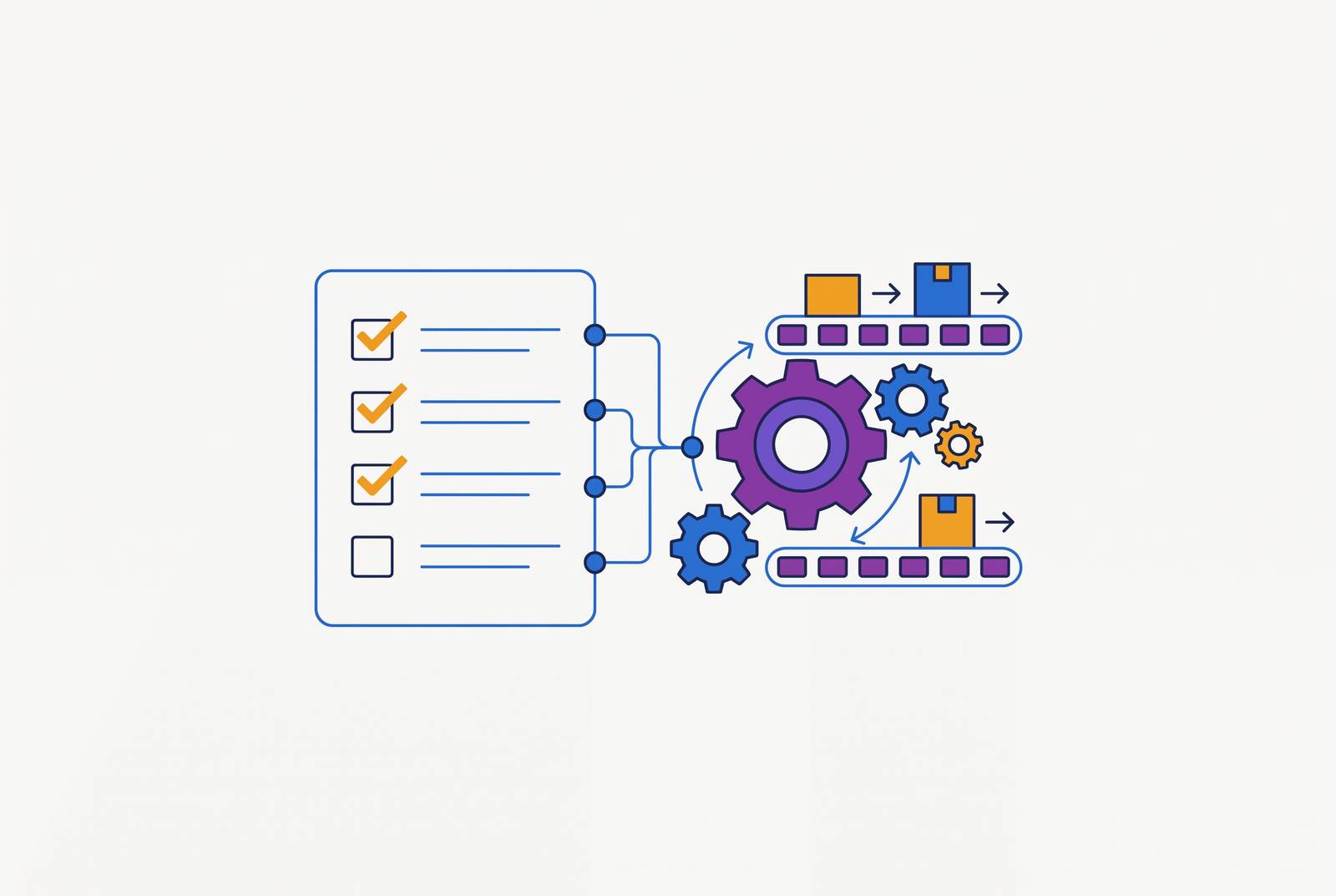
Automation built on an undocumented process does not simplify that process; it copies every inconsistency in it and repeats the copy at machine speed. This piece lays out what a workflow document must contain before an administrative task is handed to an AI agent, and why skipping that step in healthcare carries costs that go beyond a failed deployment.
Why automation breaks when the underlying process is undocumented
A computer-use agent works by watching a screen and acting on what it sees: reading a screenshot or an interface element, clicking, typing, moving to the next field. That mode of operation is fundamentally different from API-based automation, which reads and writes structured data no matter how a human happens to perform the task. A screen-operating agent doesn't get that shortcut. It inherits the process exactly as people run it day to day, rather than as the policy manual says they should run it. Whatever inconsistency, shortcut, or undocumented habit exists in the real workflow becomes part of what the agent learns to do.
That dependency creates an immediate problem wherever staff deviate from each other. If one employee starts a task from a different screen than a colleague, enters fields in a different order, or confirms a step through a different button, the agent has no single process to follow. It will either guess and lock in one version arbitrarily, or it will run into the variant it wasn't built for and simply stop. Neither outcome is a software bug in the usual sense. Both trace back to a process that was never pinned down. Documentation, in this light, is not a nice-to-have that improves automation efficiency.
How healthcare administrative workflows compound the documentation problem
Healthcare makes this problem worse than most industries because its administrative work rarely happens inside one system. A typical health system runs several electronic health record platforms side by side, each with its own data model and limited ability to talk to the others, and staff have built informal workarounds over years to move information between them, workarounds that exist nowhere in writing. Prior authorization, scheduling, and claims submission each cross at least three systems: the EHR, a payer portal, and a practice management platform, and every handoff between those systems is a decision point that staff navigate by memory and habit rather than by any documented rule.
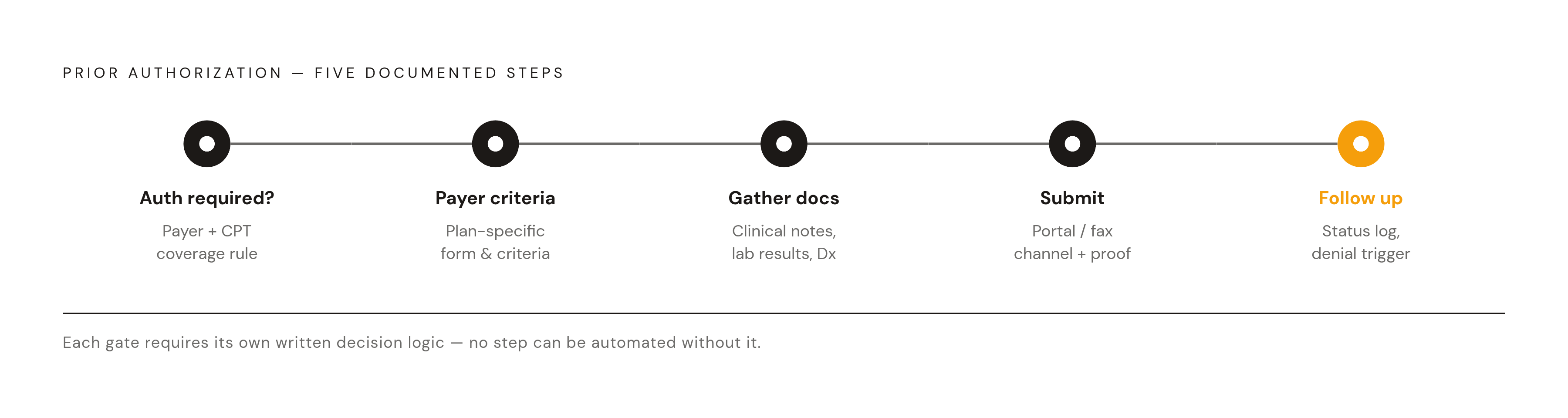
Prior authorization shows how deep this goes. The task is not one step but at least five: figuring out whether a given service needs authorization at all, finding the payer-specific requirements that apply, pulling together the clinical documentation to support the request, submitting it through a portal or by fax, and following up on anything still pending. Each of those five steps carries its own timing rules and its own decision logic, and each one has to be captured on its own before any part of the workflow can be handed to an agent with confidence.
The lesson from organizations that have already gone through this is to start small. North Shore Community Health, a Federally Qualified Health Center in Salem, Massachusetts, found that staff only grew comfortable with AI in their referral workflows after they saw it succeed on a narrow, clearly bounded problem. Confidence followed clarity. That ordering matters for any practice administrator weighing where to begin.
Capturing a workflow so it's usable by an agent
A workflow document that will actually support automation has to go well past a general description of the task. It needs five specific things, and leaving any one of them out produces a predictable failure mode once the agent is running live.
The starting point has to be exact. The agent needs to know which system it opens first and what condition that system is in when the workflow begins: the specific module, queue, and filter that should be active, not a vague instruction like "log into the EHR". If the process looks different depending on who's running it, say front desk staff versus billing staff working the same queue, that is two workflows, and each needs its own document.
Every system the process touches has to be listed in the order the work actually moves through them. A screen-operating agent switches between applications the same way a person does, by recognizing a cue that it's time to leave the EHR and open the payer portal, so the documentation has to state what that cue is. These switches are often the weakest point in any automation built on an undocumented process, precisely because staff perform them without thinking about it and therefore never think to write them down.
Every branch point needs its decision logic spelled out. If a payer requires extra documentation for certain procedure codes, that rule belongs on paper: which codes trigger it, where the supporting documentation comes from, and what format the payer will accept. A rule that lives only in one employee's memory is invisible to an agent, and it has to be surfaced and written down before that part of the workflow can be automated. Data quality matters here too: inaccurate patient or eligibility data is behind 27% of prior authorization and claims denials in some studies, and the documentation process is the point at which a practice should pin down exactly where that data gets checked and by whom.
Each step needs a visible marker of success. An agent working from screenshots has to know what a completed step actually looks like on screen, a confirmation message, a status field that changes, a case number that appears, so it can tell whether a task finished or silently failed.
Finally, the document needs to cover what happens when things go wrong. What happens if the payer portal is down? If a case is missing a required field? If a patient's insurance has changed since their last visit? Every exception that a staff member currently resolves through judgment has to become a documented rule, or it becomes the exact place where an agent either stalls or takes an action no one approved.
Capturing a workflow that staff perform but cannot fully articulate
The person who runs a given workflow most smoothly is often the worst person to ask to describe it, simply because years of practice have turned the steps into habit rather than something they consciously narrate. Asking that employee to write down what they do tends to produce a clean, simplified version that leaves out the very judgment calls and workarounds that make the process actually function.
Screen recording solves this better than an interview does. Recording a staff member performing the task live shows which application opens first, what gets typed where, when the window changes, what response the system gives back, and what visible outcome signals the task is done. The recording's job is to give whoever is building the documentation an accurate reference they can turn into structured instructions, annotated screenshots, decision rules, and an actual automation flow.
Once the recording exists, a structured conversation with that same staff member fills in what the video can't show: why they picked one path instead of another, what they glance at before moving to the next screen, what they do the moment something looks off. This is where the tacit judgment gets converted into an explicit rule.
It helps to repeat this process with two or three different people doing the same job. Watching the same workflow performed by multiple staff members surfaces variation, different sequences, different shortcuts, different ways of handling the same exception, and that variation has to be reconciled into one canonical version before any of it gets built into an agent. That reconciled version should then go to a supervisor or a compliance lead for review: the workaround staff settled on over time doesn't always match written policy, and some of those gaps carry downstream risk worth catching before automation locks them in.
HCA Healthcare's approach to deploying AI leans on exactly this kind of collaboration with the clinicians and staff who do the work, paired with careful validation before anything scales up. The documentation phase described here is where that collaboration actually happens in practice.
Which administrative workflows to document and automate first
Not every administrative task is equally ready to be documented and automated, and picking the wrong one first burns documentation effort while also costing the program credibility with staff who were watching to see if it would work. High-volume workflows with a structure that doesn't change much from one instance to the next, and clear boundaries around where the task starts and ends, are the ones worth tackling first.
Prior authorization fits this profile well. The volume is high, the payer-specific rules already exist in writing in payer policy documents, and the outcome is binary: approved or denied. The documentation effort spans five distinct steps, each with defined inputs and outputs, across a known and bounded set of payers, but it's tractable precisely because the scope doesn't shift once it's mapped.
Claims submission and denial management fit a similar pattern. Clean-claim submission follows a consistent structure, so the documentation work mostly involves mapping each field on the claim back to where it lives in the EHR and defining the checks the agent needs to run before it submits anything. Denial management is messier, but most denials cluster into a handful of root-cause categories, so the logic can still be written out as a decision tree rather than treated as something new every time.
New patient scheduling and referral intake belong on this list too. Scheduling is high-volume and structurally repetitive, the kind of profile that research on long-horizon agent tasks identifies as well suited to autonomous agents once the recurring sub-workflow logic has been captured, including through direct observation of how staff perform it. Referral intake crosses several systems, the referring provider's record, the EHR, the scheduling platform, and involves several distinct decisions: verifying insurance, matching the right provider, choosing the correct appointment type. Each of those decisions needs its own documentation before the whole intake process can be handed off. Done well, this kind of integration with existing practice management systems has been shown to cut no-show rates by at least 15% in published findings, and that result depends on the workflow specification being clean going in.
Some workflows are better left for later. Anything with a high rate of exceptions, anything tied to policy that changes often, or anything where the outcome depends on clinical judgment rather than a fixed rule should wait until the simpler workflows are running reliably. These processes can still be automated eventually. It reflects the fact that documenting them well enough to validate is simply harder, and a practice that starts with its hardest workflow risks struggling publicly before it has built any track record to fall back on. Starting narrow and succeeding builds the internal credibility needed to expand the program. Starting with the most complicated workflow in the building tends to undermine the whole effort before it gets off the ground.
The compliance obligations that make documentation non-negotiable in healthcare specifically
In most industries, a poorly documented automation produces bad output that someone eventually notices and fixes. In healthcare, a poorly documented automation can generate a non-compliant record the moment it is transmitted, with payer and legal exposure attached to it immediately.
Every AI-assisted administrative decision needs to be logged in enough detail that someone could reconstruct why the action was taken, and that's only possible if the underlying workflow was defined precisely enough to know what "the basis for the action" actually means. When an agent submits something automatically, a prior authorization request, a claim, a clinical documentation entry, without a human reviewing each step, whatever documentation existed at the moment of submission becomes the record the payer relies on for its decision. If the workflow specification was vague going in, that transmitted record can end up misrepresenting the clinical or administrative facts, and there's no step afterward to catch it.
HIPAA obligations attach to every system the agent touches, including systems beyond the primary one. The workflow documentation has to identify each system involved, confirm how PHI is handled at each step, and establish what the audit trail needs to look like before the agent ever goes live. SOC 2 Type II and HIPAA certification on the agent platform address the infrastructure layer, but they don't substitute for documenting how patient information actually moves through a specific workflow. Those are two different layers of assurance, and a practice needs both.
HCA Healthcare's Responsible AI Governance Council, made up of cross-functional leaders overseeing AI deployments, reflects where this kind of oversight actually needs to sit: inside the design of the workflow, not added on after the agent is already running.
The objection that documentation requirements slow down automation adoption
The strongest pushback against everything above is practical: thorough documentation takes time, and most AI deployments start paying off quickly, so insisting on complete documentation risks delaying returns a practice can't afford to put off. That objection carries real weight, and dismissing it outright would be dishonest. Some practitioners also point to frontier models that can pause and re-evaluate when they hit an unfamiliar screen rather than barreling ahead incorrectly, which they take as evidence that documentation gaps now matter less for reliable execution.
The evidence doesn't support that comfort. Benchmarks built around realistic, long-horizon professional tasks show that even the strongest current models complete well under a tenth of those tasks end to end, and the failures cluster in exactly the areas documentation is meant to address: planning, tracking state across steps, and recovering from errors. Adaptiveness inside a model doesn't substitute for a process that was actually pinned down before the agent started running it.
The resolution isn't to demand a fully documented operation before any automation touches the building. It's to document one workflow completely, deploy it, and use what that deployment teaches to document the next one. North Shore Community Health's referral workflow shows the pattern: a single well-scoped, well-documented deployment built the staff confidence and the institutional knowledge that made the next automation easier to pursue. Deploying on a process that was never documented just defers the documentation work. It just delays that work until after something breaks, when it has to happen under pressure, during a failure investigation, with far less control over how it turns out.