Pilot Design for Healthcare Automation That Produces Real Signal
Designing pilots to measure impact upfront separates signal from noise in healthcare automation.

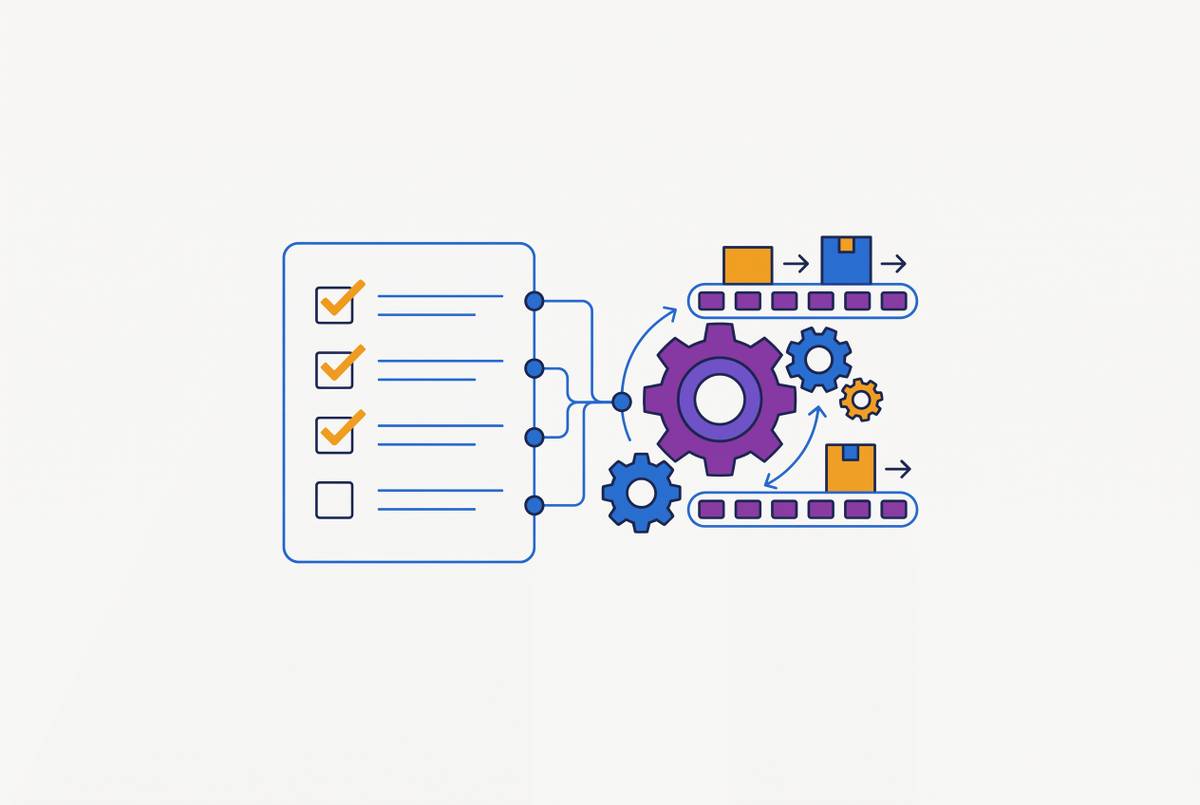
Most healthcare automation pilots fail because nobody designed the pilot to measure the right thing before the agent ever touched a workflow, not because the technology falls short. They fail because nobody designed the pilot to measure the right thing before the agent ever touched a workflow. The pattern is familiar to anyone who has sat through a pilot readout: leadership gets a deck full of numbers that neither confirm nor deny the technology's value, and the project just sort of stalls, unresolved, waiting for a decision nobody feels equipped to make. That outcome traces back to a sequencing problem. Pilots are routinely scoped and staffed after the vendor has already been selected. The measurement framework gets bolted on as an afterthought rather than built as the foundation.
Healthcare is particularly exposed to this failure mode. Administrative workflows rarely live inside one system; they cross the EHR, a payer portal, a scheduling tool, sometimes a fax queue that nobody wants to admit still matters. Staffing varies by location, and baseline conditions are almost never documented with any rigor. So when a pilot starts, there's no stable floor to measure against, and any improvement (or regression) becomes a matter of interpretation rather than fact.
The stakes for getting this right have gotten higher, not lower. That gap between appetite and trust doesn't close on its own. Poorly designed pilots don't just fail to close it, they tend to calcify it, because an ambiguous pilot reads as evidence that the skepticism was warranted all along rapidclaims.ai experian.com.
What follows is a framework for pilot design that treats scoping, baseline-setting, KPI selection, and signal interpretation as the actual deliverable, not paperwork around the deliverable. Get them wrong, and no amount of technology performance will save the readout.
What makes healthcare automation workflows hard to pilot well
Administrative workflows in healthcare are multi-system by construction. A single prior authorization might touch the EHR, a payer portal, a fax queue, and a scheduling system in sequence, and no one of those systems holds the full picture of what happened. That matters for pilot design because it means measurement can't live in just one place either. If a pilot only pulls data from the EHR, it will miss whatever happened, or went wrong, in the payer portal.
Computer-use agents complicate this further, precisely because of how they work. Rather than connecting through pre-built integrations, they operate the way a staff member would: reading a screen, clicking a button, typing into a field. That mode of operation means the pilot has to capture what happens across the entire workflow and measure the output at the end. And it's exactly this mode of operation that runs into a well-documented set of failure conditions. Payer portal timeouts, multi-factor authentication prompts, dynamic form fields, and CAPTCHA are all recognized failure modes for screen-operating agents. A pilot that only tracks the cases where everything went smoothly will produce a picture of performance that looks nothing like production.
The research literature backs this up in more granular terms. OS-Marathon, a benchmark built around 100 long-horizon repetitive tasks spanning five scenarios and ten domains, found that leading computer-use agents struggle substantially once workflows stretch across many steps and high volume OS-Marathon: Benchmarking Computer-Use Agents on Vast-Horizon, Repetitive Tasks. Errors don't stay contained to the subtask where they occur, they accumulate and propagate forward, and simply breaking a task into smaller pieces doesn't fix the problem OS-Marathon: Benchmarking Computer-Use Agents on Vast-Horizon, Repetitive Tasks. For pilot design, the implication is concrete: the pilot needs to deliberately stress-test how the agent handles exceptions and not just tally up average-case throughput and call it a day.
Staff often execute what looks like the "same" task differently depending on the individual and the location, so a pilot needs to be explicit about which workflow variant it's actually measuring. And volume is rarely flat. Scheduling backlogs spike after holidays, denial volumes spike after payer audits, and a short pilot window can easily miss the peak-stress conditions, and missing them means the pilot cannot show a system holds up in practice.
Choosing the right workflow to pilot first
The wrong reason to pick a pilot workflow is that it's the most expensive item on the books, or the one the vendor happens to be most excited to demo. Neither of those criteria has anything to do with whether the pilot will produce a clean signal. The right criteria are more mundane: high volume, well-defined completion criteria, current-state performance that can actually be measured, and low clinical risk if the agent gets something wrong.
Risk classification does real work here. Scheduling and referral intake is low-to-medium risk, since an incorrect scheduling action inconveniences a patient but doesn't touch clinical safety directly, and researchers classify this kind of workflow as suitable for what's called Human-on-the-Loop oversight healthitanswers.net OS-Marathon: Benchmarking Computer-Use Agents on Vast-Horizon, Repetitive Tasks. That makes scheduling and intake strong candidates for a first pilot. Claims and prior authorization workflows sit in a different category. Around 15% of healthcare claims get denied on first submission for avoidable reasons, and payers are increasingly using AI on their own end to process denials faster than manual workflows can keep pace with kore.ai. An agent error in that environment carries financial and time-sensitive consequences, and the oversight design in the pilot has to be tighter from the start kore.ai.
Beyond risk category, the workflow itself should resolve to a binary outcome. The prior authorization was submitted, or it wasn't. The appointment got booked, or it didn't. Workflows where "quality" is a matter of judgment make for a bad first pilot, because there's no clean way to score the result afterward. Resist the temptation to carve out the hard cases in advance. If the agent only ever sees the easy instances and every exception gets routed to a human by design, the pilot won't reveal anything about what production performance will actually look like once the carve-out disappears.
Location affects whether pilot results transfer to the rest of the group. Piloting at a single site with unusual staffing or an atypical patient mix produces a result that may simply not transfer to the rest of the group. Choosing a site whose volume and payer mix roughly resembles the broader organization gives the pilot a better shot at meaning something once it's over.
Establishing a pre-go-live baseline that the pilot can be measured against
Ask most practices how long a prior authorization takes, or how many get submitted in a given week, or what their first-pass approval rate runs at, and the honest answer is usually a shrug followed by a guess. That absence of a real baseline is the single biggest reason pilots produce phantom improvement: without a documented starting point, almost any activity looks like progress, whether or not it actually is.
Before an agent goes anywhere near a live workflow, several things need to be captured with precision. Volume: how many instances of the workflow get completed per day or week, and by how many staff members. Cycle time: the average and median time from initiation to completion. Error rate: how much rework, resubmission, or denial traces back to process mistakes rather than clinical judgment. Staff time allocation: the total hours per week the workflow consumes across everyone who touches it. And exception rate: the share of instances that required a human to step in and handle something manually.
Timing matters as much as the categories themselves. The baseline measurement window needs to match the pilot's own window; capturing two weeks of baseline data and then running an eight-week pilot invites a seasonality mismatch that will muddy the comparison later. Where it's practical, shadow logging, running the baseline capture alongside normal operations for two to four weeks before go-live, beats relying on staff recollection or a retrospective pull from billing records.
Documentation of the current workflow, step by step, needs to happen before automation touches it. Agents that plug into existing systems and operate inside a defined process tend to produce results that can actually be measured; agents dropped onto an undocumented workflow just add a second layer of ambiguity on top of the first. Before anyone gets attached to a number, settle in plain language what counts as "done."" Does a prior authorization count as complete once it's submitted, or only once it's approved? Does a scheduling workflow finish at booking, or only once the appointment is confirmed? Get this wrong and the pilot readout turns into an argument about definitions instead of a decision about deployment.
Defining KPIs before go-live so the pilot has a predetermined pass/fail threshold
KPIs need to get locked in with the vendor before go-live, not chosen after the results have already landed on the table. Selecting metrics after the fact is precisely how vendor-favorable numbers end up crowding out the ones the practice actually cares about; whoever controls the metric after the data exists controls the story the data tells.
The metrics also need to be specific to the workflow rather than generic. A scheduling pilot should track booking rate, no-show rate, and time-to-appointment. A prior authorization pilot should track submission volume, first-pass approval rate, and cycle time reduction. A single catch-all "productivity improvement" figure hides which dimension actually moved and which didn't. And any vendor-reported figure, a claimed 98% first-pass approval rate, a claimed 70% reduction in scheduling time, needs independent verification inside the pilot itself; those numbers are self-reported and belong in the conversation about setting targets, not as a stand-in for the pilot's own results rapidclaims.ai.
It helps to separate output KPIs from outcome KPIs explicitly. Output KPIs, things like the number of authorizations submitted or appointments booked, measure the agent's direct production. Outcome KPIs, things like denial rate, days in accounts receivable, or provider utilization, measure the downstream result that actually affects the practice's finances. Both categories matter, but they answer different questions: output KPIs tell you whether the agent is functioning, outcome KPIs tell you whether that functioning is worth anything. One KPI belongs in every pilot regardless of workflow: the exception-handling rate, tracked explicitly, showing what share of instances required a human to step in and why. This is consistently where agents underperform relative to how they looked in the demo.
None of this matters without a pre-agreed threshold for what triggers rollout. A statement along the lines of "if the agent hits X on KPI A and Y on KPI B, the practice proceeds to full deployment" turns the eventual readout into a decision rather than a negotiation. The reverse deserves equal attention: agree in advance, and write down, what result constitutes a failed pilot that ends the engagement. Without that agreement, sunk cost quietly takes over the decision.
Structuring the pilot operationally so the signal stays clean
Scope containment comes first. The pilot needs a defined workflow, a defined patient or claim population, and a defined time window, and none of those should move once the pilot starts. Expanding scope mid-pilot, even with good intentions, invalidates whatever baseline comparison was set up at the outset.
Human staff should keep handling a parallel slice of the same workflow during the pilot rather than handing the whole thing to the agent. That concurrent comparison is what lets the readout measure actual agent performance against actual human performance in the same period, rather than against a historical baseline that may no longer reflect current conditions. Every agent action, meanwhile, needs a timestamp and an outcome logged against it; an agent's output is only as trustworthy as the audit trail behind it, and this lines up with the HIPAA Security Rule's audit control requirement to record activity in any system touching ePHI, even though the specific fields to log come from NIST guidance rather than from HIPAA's text directly.
Exceptions need a defined escalation path decided before go-live: who gets notified, how fast, and how the handoff gets logged, so that exceptions appear consistently in the data instead of disappearing into someone's inbox or a hallway conversation. Watch, too, for a subtler failure mode: staff quietly routing the hardest cases to themselves while letting the agent handle only the easy ones. That kind of self-selection will overstate agent performance if case assignment rules aren't set and enforced before the pilot begins.
A midpoint check-in earns its place on the calendar. Waiting until the final readout to discover a logging gap, a data collection failure, or an exception volume nobody anticipated means there's no runway left to fix it. And none of this operates in a vacuum, security-wise. Agents moving across EHRs, payer portals, and billing systems are handling PHI at every step, so SOC 2 Type II certification and HIPAA compliance, including a signed BAA, need to be confirmed before the pilot starts, not folded into procurement after the fact.
Reading the pilot results and turning them into a deployment decision
The readout is not a discovery session. The KPI targets and pass/fail thresholds got set before go-live, so the first question at readout is simply whether they were met, not what story the data seems to tell in the moment.
The results deserve disaggregation before anyone draws a conclusion. Overall average performance can clear the bar while performance on exceptions remains genuinely poor, and those two numbers need separate treatment rather than a blended average that hides the weaker one. The ratio of exceptions to routine cases in actual production decides whether the system delivers on its promise or quietly falls short of it.
ROI gets evaluated against the workflow-specific KPIs set at the start, not against vendor benchmarks or industry-wide averages, because every practice carries a different cost structure and a different bottleneck rapidclaims.ai. A vendor's case study claiming a 1.7x productivity gain is directional at best, useful for calibrating expectations, not a substitute for the practice's own number rapidclaims.ai.
A handful of failure patterns occur often enough to name directly. The pilot may have worked, but only on the subset of cases the agent was pre-configured to handle easily, something the exception rate will expose if it's being tracked honestly. Output KPIs might improve while outcome KPIs stay flat, which usually means the agent is completing the workflow while the real bottleneck sits somewhere else downstream. And staff may have adjusted their own behavior during the pilot in ways that flatter the agent's numbers, and the concurrent human-workflow comparison exists to catch that.
The decision at the end isn't binary, and treating it as one is a mistake. Four outcomes deserve equal standing going in: full deployment as scoped, deployment with workflow modifications, a re-pilot with narrower scope, or discontinuation. Defining all four in advance means the readout produces a clear next step instead of handing the decision to a committee that has to invent criteria on the spot. A pilot at a single location also doesn't validate performance across a multi-location group or an enterprise health system; scaling calls for its own phased rollout with its own measurement framework, not an assumption that one site's result covers the whole portfolio. And regardless of which of the four outcomes gets chosen, the workflow documentation, the baseline data, and the exception taxonomy built during a well-run pilot retain their value on their own. That groundwork doesn't evaporate just because the automation decision goes one way or the other.