Evaluating AI Vendors for Independent and Multi-Location Medical Groups
Medical groups need clear criteria to avoid locking into the wrong AI vendor.

Independent and multi-location medical groups are about to make a category of purchasing decision most of them have never faced before, and the vendors selling agentic AI right now are not interchangeable. Pick wrong and a practice gets locked into automation that fixes one problem while leaving eight others exactly as broken as they were. The market moves fast enough that correcting course later costs real money, not just embarrassment.
Agentic AI has already outgrown its first reputation. It started as ambient scribes, tools that listen to a visit and draft a note, and has become something closer to a coworker: software that verifies insurance eligibility, submits a claim, and follows up on a denial without anyone clicking through each step by hand. Projections put agentic AI in healthcare growing at a compound annual rate several times higher than typical tech-sector growth through 2030, closing in on $5 billion in market size. A curve that steep rewards buyers who ask hard questions early and punishes the ones who signed with whoever ran the slickest demo.
Most small and midsize practices in 2026 run somewhere between eight and twelve separate software platforms, including an EHR, a clearinghouse, a scheduling tool, a patient communication platform, and maybe two or three payer-facing portals, each with its own login, its own contract, its own support line, its own island of data that talks to nothing else. A vendor that plugs into just one of those islands hasn't reduced the fragmentation. It has added a thirteenth login and called it progress.
BCG's analysis of AI transformation found that organizations seeing real returns concentrate on a small number of high-value opportunities instead of scattering pilots across the org chart. Pick the wrong vendor and a practice ends up with the opposite: a pile of half-finished automations, each one requiring babysitting, none of them reaching the finish line unattended. A large health system with an IT department and a change management office absorbs that as an inconvenience. An independent group or a lean multi-location practice absorbs it directly into staff hours, revenue leakage, and longer waits in the lobby. The margin for error is thin here, and the questions below exist to protect it, not by ranking products, but by giving any administrator a way to hold any vendor to the same standard.
What an AI agent is (and what it is not) before evaluating one
A practice can't compare vendors without a shared definition of what it's buying, because "AI agent" gets stretched to cover things that aren't agents at all, and vendors rarely correct the confusion when it works in their favor.
An AI agent, properly defined, is an autonomous software system that interprets a request, pulls context from the EHR or a payer system, applies some policy or logic to decide what happens next, and carries the task through to completion. That last part is the whole distinction. An agent doesn't just answer a question; it moves work forward on its own, without a human re-initiating each step.
Most of what's already sitting in practice tech stacks doesn't clear that bar. AI scribes transcribe and summarize a visit, which is documentation help, not workflow execution: the note gets written, but nobody submitted a claim or checked an eligibility file. Chatbots handle FAQs and scripted flows and stall the second a request wanders off-script. Traditional robotic process automation logs into legacy systems and clicks through fixed sequences, fine until a payer portal changes its layout, at which point the script breaks and someone has to rebuild it by hand.
Computer-use agents work differently. They operate software the way a staff member would: reading the screen, deciding where to click, typing into the right field, navigating between pages, using large language model-based vision and reasoning to adapt when the environment shifts underneath them. Multi-agent systems go further still, coordinating handoffs between agents across a workflow, though adoption of that architecture remains limited in practice.
The screen-operating approach matters specifically in healthcare because of how the terrain is built. Prior authorization, appeals, and durable medical equipment order processing don't live inside one clean system. They span payer portals, fax machines, and document exchange tools that were never built to talk to each other through an API. A benchmark called HealthAdminBench, published for an ICLR 2026 workshop, tested agents across four environments built to mirror exactly that mess: an EHR, two separate payer portals, and a fax system. That's the real terrain, and any vendor claim needs to be measured against terrain like it, not against a tidy internal demo. A product that looks flawless inside a vendor's own integrated sandbox can behave very differently once it's asked to work across a practice's actual, disconnected stack. Category clarity is what makes that comparison possible at all.
The Performance Gap Vendors Don't Advertise
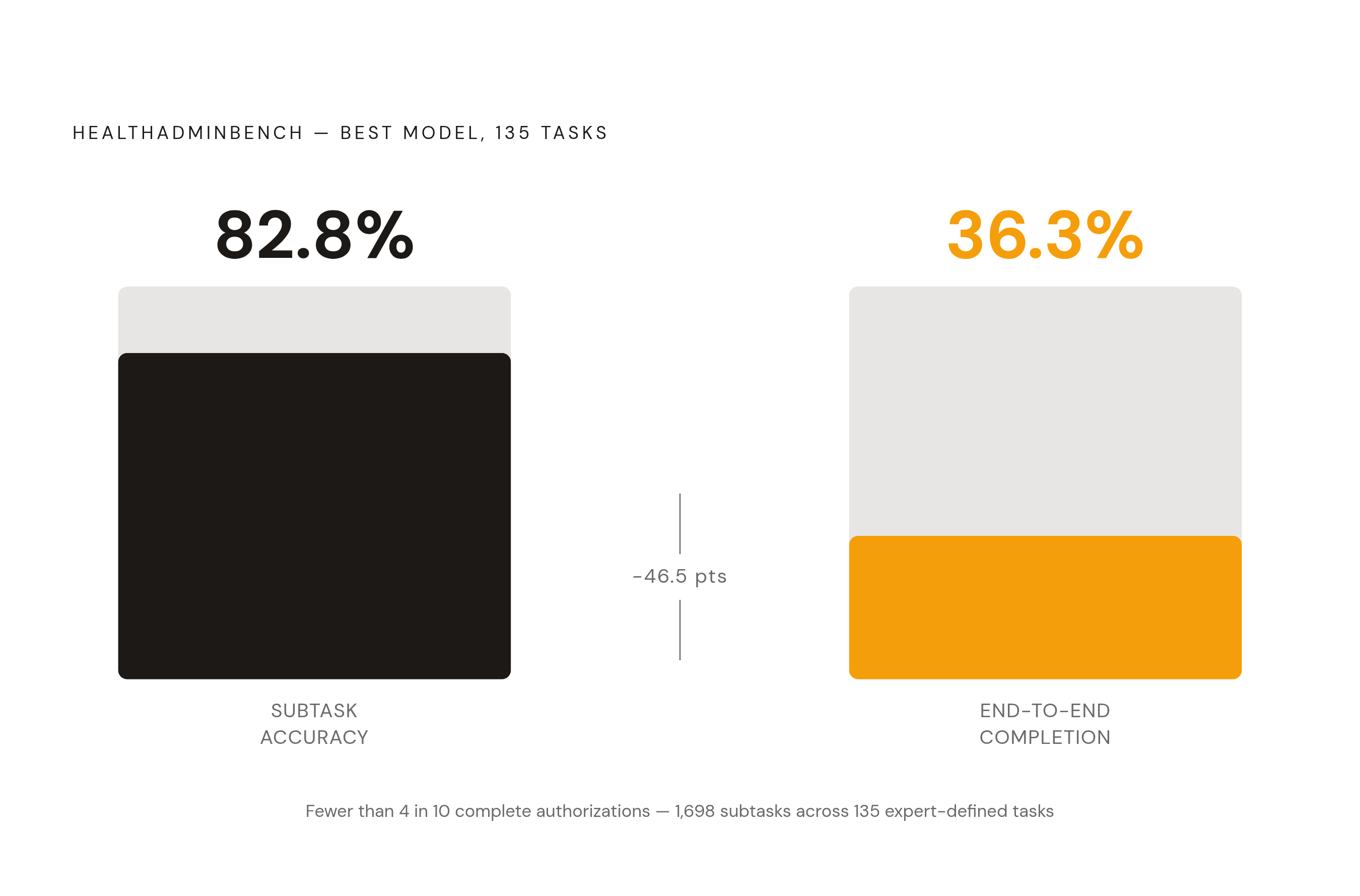
Here's the number that should change how every administrator reads a vendor's pitch deck. HealthAdminBench evaluated 135 expert-defined tasks spanning prior authorization, appeals and denials, and DME order processing, broken into 1,698 verifiable subtasks. The highest subtask success rate recorded across models was 82.8%. The best end-to-end task completion rate was 36.3%.
Sit with that gap. A vendor can honestly report accuracy in the low-to-mid 80s and still be describing a system that finishes fewer than four out of ten complete authorizations without failing somewhere along the way. Subtask accuracy and end-to-end completion measure different things entirely, and a practice that doesn't ask which number it's being quoted will assume the flattering one applies to the outcome it actually cares about.
A billing team doesn't care whether the agent filled in the diagnosis code correctly. It cares whether the authorization got submitted, complete, in a form the payer will actually approve. An agent that nails every individual field but drops the ball on packaging and submitting the request has produced nothing usable, no matter how the subtask score reads on a slide.
Research into computer-use agents found that under screenshot-only operation, one model configuration scored roughly ten times lower than another on healthcare administration tasks. The bottleneck wasn't the instructions the agent received. It was pixel grounding, the basic mechanical task of correctly reading what's on screen and clicking the right thing. "AI performance" in this category isn't one skill, it's several stacked on top of each other, and a weakness anywhere in that stack tanks the whole chain.
So ask directly. What metric is being quoted, subtask accuracy or end-to-end completion? Measured in what environment, a sandbox built for the demo or the practice's actual EHR and payer portals? And when the agent fails partway through a task, does it flag the failure to staff, retry on its own, or drop the work silently and move to the next one? That third question tends to separate a vendor that has thought through production failure from one that has only thought through the sale.
Workflow breadth: which administrative tasks the vendor covers end to end
The administrative load on a practice was never confined to one bottleneck, so a single-task vendor can only ever be a partial fix, before looking at coverage maps.
Physicians spend more than 13.5 hours a week on documentation. Ambulatory physicians log an average of 5.8 hours actively inside the EHR for every 8 hours of scheduled patient time, nearly as much time typing as seeing patients. Meanwhile revenue cycle losses from denials and uncollected payments reached an estimated $48 billion in 2025. That figure is a breakdown spanning eligibility checks, claim scrubbing, denial classification, appeal drafting, and follow-up, each one a separate place where a claim can die before it gets paid. It's a breakdown spanning eligibility checks, claim scrubbing, denial classification, appeal drafting, and follow-up, each one a separate place where a claim can die before it gets paid.
Referral leakage. Cancellation recovery. Real-time eligibility verification. Prior authorization. Each is its own point of failure, and a vendor that automates exactly one of them has patched exactly one leak in a boat with several.
A practice evaluating coverage should map its own workflow against the real categories: prior authorization (submission, status tracking, peer-to-peer scheduling), claims processing (scrubbing, submission, status tracking), denials management (classification, documentation gathering, appeal drafting, follow-up), eligibility verification (checked against live payer databases before the patient walks in), inbound scheduling (new patient intake, referral scheduling, cancellation recovery), clinical documentation (ambient capture, structured field population, coding support), and patient communications (reminders, pre-visit intake, post-visit follow-up).
Swapping one silo for a smarter silo doesn't solve the reality that most practices run between eight and twelve separate platforms. That gets solved only when a single agent infrastructure can work across the entire arc from first patient contact to final payment, which is a far higher bar than most vendor pitches actually clear.
Multi-location groups carry an extra wrinkle. A larger ownership group running dozens of sites needs workflow coverage that holds up uniformly across all of them, not a bespoke build for every location. What happens when a new site comes on board running a different EHR or a different payer mix? If the answer involves a fresh integration project every time, that's repeated custom work billed as a platform. That's repeated custom work billed as a platform.
Here's the test an administrator can run before signing anything: trace every manual step staff touch during a single patient encounter, from the first phone call to the day the claim gets paid, then ask the vendor to show, not describe, which of those steps their agent completes without a person triggering it by hand.
Integration approach: how the vendor connects to systems the practice already uses
Two philosophies of integration compete in this market, and they lead to very different deployment experiences, so the choice between them is not cosmetic.
API-dependent vendors need the EHR or payer portal to expose a supported endpoint they can plug into. Plenty of payer portals and a fair number of legacy EHRs simply don't offer one, and when a portal updates its interface, the integration built against it often has to be rebuilt from the ground up. Screen-operating computer-use agents take a different path: no API required, no EHR replacement necessary, because they interact with a system the way a staff member does, which lets them work across whatever stack a practice already has. Traditional RPA is somewhere in between, scripting screen interaction without adaptive reasoning, brittle the moment a page's layout shifts even slightly.
This isn't an abstract technical preference. The 2025 CAQH Index found that electronic transactions and automation already helped the healthcare industry avoid an estimated $258 billion in administrative costs in 2024. Practices have real, sunk investment in the EHR workflows they've built over years, and they shouldn't have to rip that out just to bring an AI agent on board.
Payer portals compound the problem because they don't share a common API standard among themselves. A vendor that integrates cleanly with the EHR but stalls at the payer portal has automated the easier half of the workflow, the half that usually took less staff effort to begin with, and left the harder half exactly where it was.
Ask directly: does the agent work with this practice's specific EHR and payer portals today, or does that require a custom build? When a payer portal changes its interface, how long does the system take to adapt, and who eats that cost, the vendor or the practice? Can the practice go live with a single login, or does IT need to get pulled in for API credentialing before anything works at all?
For a group running different EHRs across different locations, this is where the two philosophies pull apart sharply. A screen-operating approach can, in principle, work across systems without a separate engineering project for each one, a structural edge over an API-first vendor in a multi-EHR environment. That advantage is real and deserves serious weight in the decision, not a passing mention on a sales call.
Deployment timeline and what "going live" requires from the practice
Enterprise health systems have implementation teams built for exactly this kind of rollout. Independent and mid-market groups don't, and they're deploying new software while running full patient volume at the same time. A months-long implementation with heavy IT lift is a direct cost against the practice's ability to see patients that week. It's a direct cost against the practice's ability to see patients that week.
BCG's 2026 analysis frames AI transformation with a rule of thumb: the algorithm accounts for a small slice of the effort, technology and data for a somewhat larger slice, and people and process for the majority of it. A vendor pitching a deployment that skips past the people-and-process piece is setting up a rollout that fails on the human side even when the underlying product works exactly as advertised.
Kaiser Permanente's 2025 rollout of Abridge's ambient documentation tool offers a sequencing lesson even for groups nowhere near Kaiser's scale. The deployment covered 40 hospitals and more than 600 medical offices and was described as Kaiser's fastest implementation of any technology in over two decades. It didn't start everywhere at once. It started with volunteer physicians and refined the workflow based on what those early users reported before expanding further. Documentation time dropped by more than half. The sequencing, not the tool by itself, is what made that possible.
An administrator evaluating a vendor should ask what "going live" actually requires from staff: new logins, IT resources, a workflow redesign, formal training, some combination of all four. What's the realistic gap between signing the contract and the first automated task actually completing? Is the deployment templated for common workflows, or does every practice get a from-scratch build? And how does the vendor handle a group running different systems at different locations?
Practices worry, reasonably, that automation means fewer jobs on staff. A well-sequenced deployment redirects staff time toward higher-value work rather than eliminating positions outright, but that outcome depends entirely on how the rollout gets managed, not on the software alone. Ask the vendor how they've handled that transition elsewhere, and ask for something concrete, not a reassurance dressed up as an answer.
A vendor that can't describe a specific deployment sequence, or that quotes a go-live date without defining what "live" actually means in practice, has given a timeline that should be treated as a floor, not a ceiling. It tends to move in one direction after the contract is signed, and it's never the direction that favors the practice.
Compliance posture: HIPAA, SOC 2, and what the vendor's security architecture covers
A recent Experian Health survey found that data privacy and security concerns are the single biggest reason healthcare leaders hesitate on AI adoption in revenue cycle management, with half of respondents naming it their top barrier. Data privacy and security concerns are the reason a lot of otherwise-promising evaluations stall before a contract ever gets drafted. It's the reason a lot of otherwise-promising evaluations stall before a contract ever gets drafted.
HIPAA certification and SOC 2 Type II compliance are the floor, not a differentiator. When a vendor leads a pitch with those credentials as though they're a competitive edge, that's often a quiet signal that the rest of the field hasn't cleared much higher a bar either.
A specific regulatory layer applies to any AI agent touching certified EHR fields. Under ONC's HTI-1 Final Rule, developers of certified Health IT modules that incorporate predictive AI decision support interventions have been required, since March 2024, to disclose source attributes along with risk management practices and performance information, with that attribution scoped to interventions the certified developer itself built rather than third-party tools layered on top. A vendor whose agent writes into EHR fields needs to be able to produce that documentation on request, not just assert accuracy and move on.
Practices should ask pointed questions about how PHI actually moves through the system. Is it processed on-device, on shared cloud infrastructure, or inside a dedicated tenant? Does the model train on customer data, and if so, under what consent and what controls? How are audit logs kept, and can the practice pull them for its own compliance review? And because a screen-operating agent logging into payer portals is often doing so using staff credentials, there's a related concern sitting right next to PHI exposure: how are those credentials stored, and who has access to them?
For a multi-location group or a large ownership portfolio, a compliance failure at one site exposes the whole entity structure instead of staying contained to that site. Does the vendor's business associate agreement actually cover every entity in the group, and do audit capabilities function at the portfolio level, not just per location?
How to measure whether an AI agent is performing, and what to agree on before signing
Vendors like to quote capability metrics: accuracy rates, workflow coverage, processing speed. None of those map directly onto what a practice administrator actually gets judged on: first-pass claim acceptance rate, days in accounts receivable, prior authorization turnaround time, appointment fill rate, cancellation recovery rate. A high accuracy number and a healthy AR cycle are not the same claim, and no vendor should get to substitute one for the other in a sales conversation.
Every practice's bottleneck looks different, so a one-size-fits-all promise doesn't survive contact with reality. A denial management agent deployed at a high-volume orthopedics group needs to be measured against that group's own baseline, not against some generic industry figure pulled from a case study. A scheduling agent at a primary care practice faces a completely different cost structure entirely. A blanket claim like "reduces denials by a fixed percentage" sounds precise and commits to nothing, because it was never tied to any specific practice's starting point in the first place.
Recent data shows that working a single denial costs an average of $57.23 per claim, up from $43.84 the year before. A practice can calculate its own baseline denial-working cost right now, hand that number to a vendor, and ask for a specific projected improvement against it, then hold that projection to account once the contract is signed and the real data starts coming in.
Before anything gets signed, a credible vendor commits to a short list of terms: named key performance indicators tied to the specific workflows being automated, not generic ones borrowed from a different client's case study; a defined measurement period and an agreed baseline the performance gets calculated against; and full transparency about how each metric is actually calculated, verifiable inside the practice's own systems rather than reported solely by the vendor with no way to check the math. A vendor that hesitates on any of those three has already told a practice how the relationship will go after the contract is signed. Listen to that hesitation before the ink dries, not after.