Exit Clauses and Data Portability Rights in Healthcare AI Contracts
Healthcare AI contracts often lack exit terms protecting patient data and workflow continuity.
Healthcare AI exit clauses and data portability rights are necessary for an organization to leave a vendor without losing PHI access, operational continuity, or years of workflow investment. They are structural requirements. The protection against lock-in is to negotiate what can leave, how it will leave, and what support survives termination before signing.
Why healthcare AI contracts now expose organizations to operational and compliance risk at exit
Practices and health systems already rely on AI agents for prior authorization, claims appeals, scheduling, and documentation. These workflows run continuously and touch PHI at every step. Yet standard agreements were written for general enterprise software, while these systems accumulate learned workflow state and bridge fragmented systems without another integration layer. That mismatch makes termination an operational event.
Vendor consolidation and model retirement have made this exposure immediate. ServiceNow’s acquisition of Moveworks closed December 2025, and Automation Anywhere’s Aisera acquisition closed November 4, 2025, putting existing customers on the acquirers’ renewal calendars and contract terms. OpenAI retired GPT-4 base in April 2025 and has continued a quarterly deprecation cadence. Anthropic’s model lifecycle policy puts most production versions on a roughly 12-month observable horizon. For healthcare organizations, data caught inside these changing systems is also a PHI governance obligation and a potential breach vector.
What the standard exit windows actually are across the major AI infrastructure providers
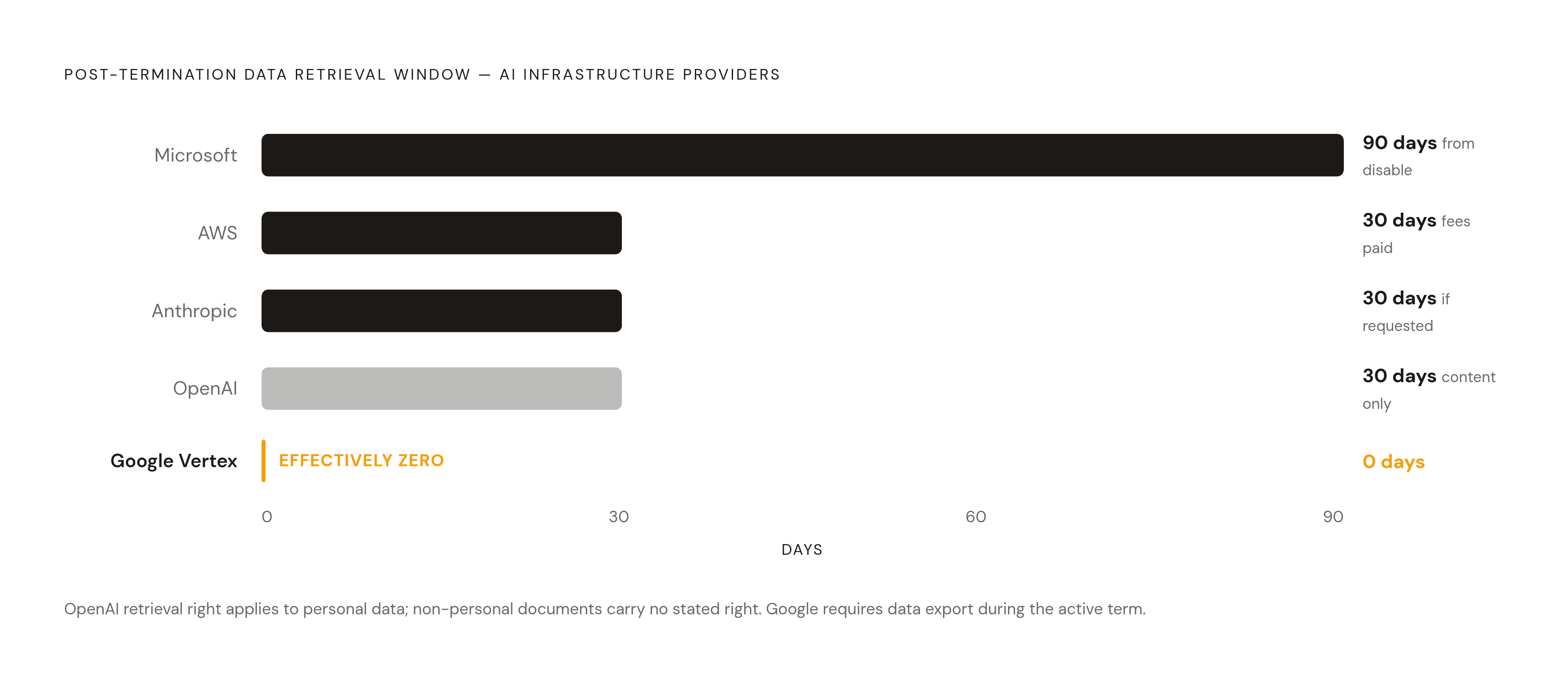
As of October 5, 2026, the five major providers’ standard terms give customers between zero and 90 days to extract data after termination. Microsoft provides 90 days from a disabled account. AWS provides 30 days, but only if all fees are paid. Google Vertex AI gives customers no time to get data back after termination, so they must ask for its return during the term. Google’s subsequent recovery period of up to 30 days and deletion within a maximum of 180 days do not constitute an equivalent retrieval right.
Anthropic’s Data Processing Addendum provides for return within 30 days if requested, with deletion if the customer misses the window. Anthropic’s main Commercial Terms, effective June 17, 2025, say only that the customer “may no longer access the Services.” OpenAI provides for content deletion within 30 days, while its DPA return right covers personal data only. Non-personal documents and outputs have no stated retrieval right under that DPA, although OpenAI’s Enterprise Privacy page separately asserts customer ownership of inputs and outputs.
Model retirement introduces another clock. Microsoft commits to 18 months from GA model launch plus 60-day email notice. Google commits to 12 months’ notice for a discontinued service unless replaced with a materially similar service, with exceptions for pre-GA services and short-term models receiving as little as 45 days. OpenAI’s documentation provides 6 months for GA models, while Anthropic’s documentation provides 60 days. AWS varies by model card between a 6-month and 45-day legacy period for models launched on or after September 7, 2026, with at least 6 months for earlier models.
These terms describe different protections. Even 90 days is inadequate for an enterprise migrating a PHI-handling agentic workflow with a fine-tuned model and a large retrieval index, and none of these standard terms promises transition assistance. Price changes add pressure, with notice as short as 14 days at OpenAI and changes possible at any time at Google unless the order form says otherwise. An order form agreed before signing can override standard terms, so that is when the organization has the best chance to change them.
Why healthcare AI creates a data portability problem that general enterprise contracts were not built to address
More time does not solve an export right that covers the wrong assets. Standard definitions of “customer data” commonly include prompts, completions, and uploaded documents. They commonly exclude, explicitly or by silence, derived embeddings, retrieval indices, fine-tuned model weights, persistent agent memory, conversation traces, and intermediate planning state. Those excluded assets can represent much of the effort that made an agent useful.
For a screen-operating agent, that effort includes learning the steps for submitting through each payer portal, payer-specific edge cases, and the logic for clinical attachments. When an agent connects EHR systems, the integration layer may be part of what it has learned. Exporting source documents alone does not preserve that workflow knowledge. Nor are vectors necessarily the most valuable retrieval assets to preserve, because re-embedding is relatively cheap when model dimensions change. The costly reconstruction lies in chunked text, chunk boundaries, metadata, and the retrieval evaluation set, which can take weeks to rebuild.
How HIPAA and BAA obligations intersect with exit terms — and why the intersection is underwritten in most contracts
A practice that has used an AI agent for prior authorization for two years has years of PHI in the vendor’s pipeline. HIPAA obligations last through the time it takes to return or destroy the data, even after access to the service ends. A BAA must therefore be signed before the system processes patient data and must set the rules for what happens afterward. It should address return or certified destruction, documented timelines, transition security, and downstream PHI processing under a BAA chain.
Training creates a separate exposure because returning records does not answer whether their use was permitted. Using PHI to train general AI models serving other clients is a major HIPAA violation unless patients explicitly authorize it or the data is properly de-identified under Safe Harbor or Expert Determination standards. Contractual limits on secondary use must therefore be explicit. Data minimization, documented retention schedules, audit rights, documentation of de-identification methodology, and breach notification obligations that survive termination also belong in the agreement.
The exit clause and BAA must work on the same timeline. If portability rights end before the vendor certifies destruction, the organization can lose both access to the data and proof that it was destroyed. As AI risk assessment requirements change, they include checking for vendor lock-in when a system becomes central to the work. That makes exit readiness a compliance concern as well as a continuity concern.
How vendor consolidation and M&A turn today's acceptable contract into tomorrow's compliance exposure
Compliance exposure can also change when ownership changes. Microsoft’s acquisition of Nuance in 2022, with an announced value of $19.7 billion inclusive of net debt and a final purchase price of $18.8 billion, restructured the ambient scribe market. EHR vendors introducing native prior auth assistants or coding support also change the market for standalone tools. Integrations that made a specialty product valuable may be discontinued.
Consolidation can lead to better products while giving customers a migration timetable they cannot accept. An ambient scribe vendor acquired during a three-year contract may require migration before the original term ends. A denial management platform acquired by an EHR competitor may lose its integration. For a hospital with separate documentation, coding, prior auth, denials, and scheduling tools, each acquisition affects a distinct BAA and integration dependency.
Anthropic’s Commercial Terms allow assignment in a business sale without the customer’s consent, while AWS may assign in a merger even though its customer needs consent to do so. Microsoft and Google require the customer’s consent for assignment to anyone other than affiliates. Standard contracts do not provide the specific penalty-free termination protection needed when an acquirer is a competitor or has a conflicting privacy policy.
The eight contract provisions that determine whether exit is an engineering project or a restart
The first provision is a complete data portability scope. Define “Customer Data” as all customer-specific state produced during operation, including derived, embedded, indexed, and intermediate forms. Where a vendor claims intellectual property rights, draw a line between the artifact the vendor owns and the customer-specific values that still belong to the customer. This turns the asset problem into an enforceable export obligation.
The second provision is a return timeline and documented format that support a full migration. Negotiate a migration timeline beyond the standard 30-day window. Require certified destruction of all copies, including sub-processor copies and vendor backups, within a stated period and with written confirmation.
The third provision is a training prohibition covering PHI, de-identified data, usage telemetry, prompts, and outputs. Prohibit training, fine-tuning, benchmarking, or model improvement except as expressly permitted in writing, and carry that restriction through the sub-processor BAA chain. Vendors may resist this restriction because it limits reuse, but that is precisely the activity the organization needs to control.
The fourth provision is contractual model deprecation notice, with 12 months as the asking position and 6 months as the floor. Require parallel availability of the retiring and successor models for a stated overlap window. A written mapping of changes to prompts or behavior should help with re-evaluation. Notice belongs in the contract because the vendor can change documentation unilaterally.
The fifth provision is penalty-free termination following an acquisition by a competitor, a company with a conflicting privacy policy, or one that fails the organization’s compliance requirements. This right must be negotiated explicitly. It may draw resistance because it limits the vendor’s ability to carry the relationship through a sale, but the customer’s governance requirements cannot depend on unchanged ownership.
The sixth provision is integration continuity through the contract term, regardless of ownership or partnership changes. Name the EHRs and payer portals on which the tool’s value depends. For screen-operating agents, make that promise cover the portal-specific and EHR-specific workflow logic the agents have built up.
The seventh provision is consent for material sub-processor changes. Changes that involve model providers, jurisdictions outside the original commitments, or new processing categories should require consent as well as notification. For changes with less impact, there should be a written objection-and-cure period. Model providers, vector database providers, and third-party tool operators can each materially alter the system originally assessed.
The eighth provision is transition assistance in the order form. Require API access and export tools for a defined period, cooperation with a successor vendor, and support for BAA transfer or termination certification for PHI-handling workflows. Data rights become usable only when the customer has the means and cooperation to exercise them.
Why operational teams and legal teams disagree on demanding these clauses — and how to resolve it
Operational teams face real pressure to get an agent live and producing value. Legal demands can appear to slow or threaten a useful relationship, especially for small or independent practices. Zapier’s 2026 survey of 542 U.S. leaders who worked with active paid AI vendor contracts found that a large majority expected disruption or said they relied fully on a key vendor if it ended service. Yet most had not negotiated exit protections. Immediate value and long-term dependency can therefore be true at the same time.
The practical resolution is to frame these terms as deployment due diligence. A refusal to commit to return timelines and formats leaves continuity outside the vendor’s post-contract responsibility. A refusal to commit to retirement notice leaves governance subject to the vendor’s migration calendar. These are operating conditions to settle before signing, while the organization still has leverage. The ability to leave also makes renewal negotiation meaningful, regardless of how well the vendor has performed.
Practices without the scale to renegotiate every standard term can focus on the order form. Prioritize data portability scope, the PHI training prohibition, and change-of-control termination rather than demanding all eight provisions simultaneously.
What a well-structured AI vendor agreement looks like for healthcare operations specifically
A sound agreement maps its obligations to the deployment rather than separating legal protections from operational requirements. Scope should name the workflows, systems, and performance milestones, with provisions for version control and retraining. The terms should say who owns the underlying data and outputs and set clear limits on secondary use and commercial exploitation. All eight exit provisions should be in the contract body or order form.
Risk allocation should distinguish causes, including model design defects, inaccurate outputs, integration errors, EHR mapping failures, data quality issues, security incidents, and regulatory penalties. Indemnification by cause is more useful than a blanket cap that excludes the most consequential categories. Those obligations should be backed by technology errors and omissions insurance, promises of performance through SLAs, and a duty to report known defects or risks.
For computer-use agents, the agreement should also define portable workflow knowledge and address access credentials and audit logs at termination. It should state the vendor’s SOC 2 Type II and HIPAA certification status and how those commitments are maintained and verified. HIPAA compliance and SOC 2 Type II certification belong among contractual baseline requirements established before deployment.
Replacing an EHR, changing established workflows, or undertaking a long custom integration creates dependencies before go-live. Deployment against existing systems without API integrations or workflow overhauls reduces that friction. The contract must preserve the same freedom by making PHI governance, workflow continuity, and exit readiness parts of one operating agreement.