SLA Structures That Actually Apply to Healthcare AI Automation Contracts
SLAs built for uptime miss how AI agents actually fail in healthcare workflows.
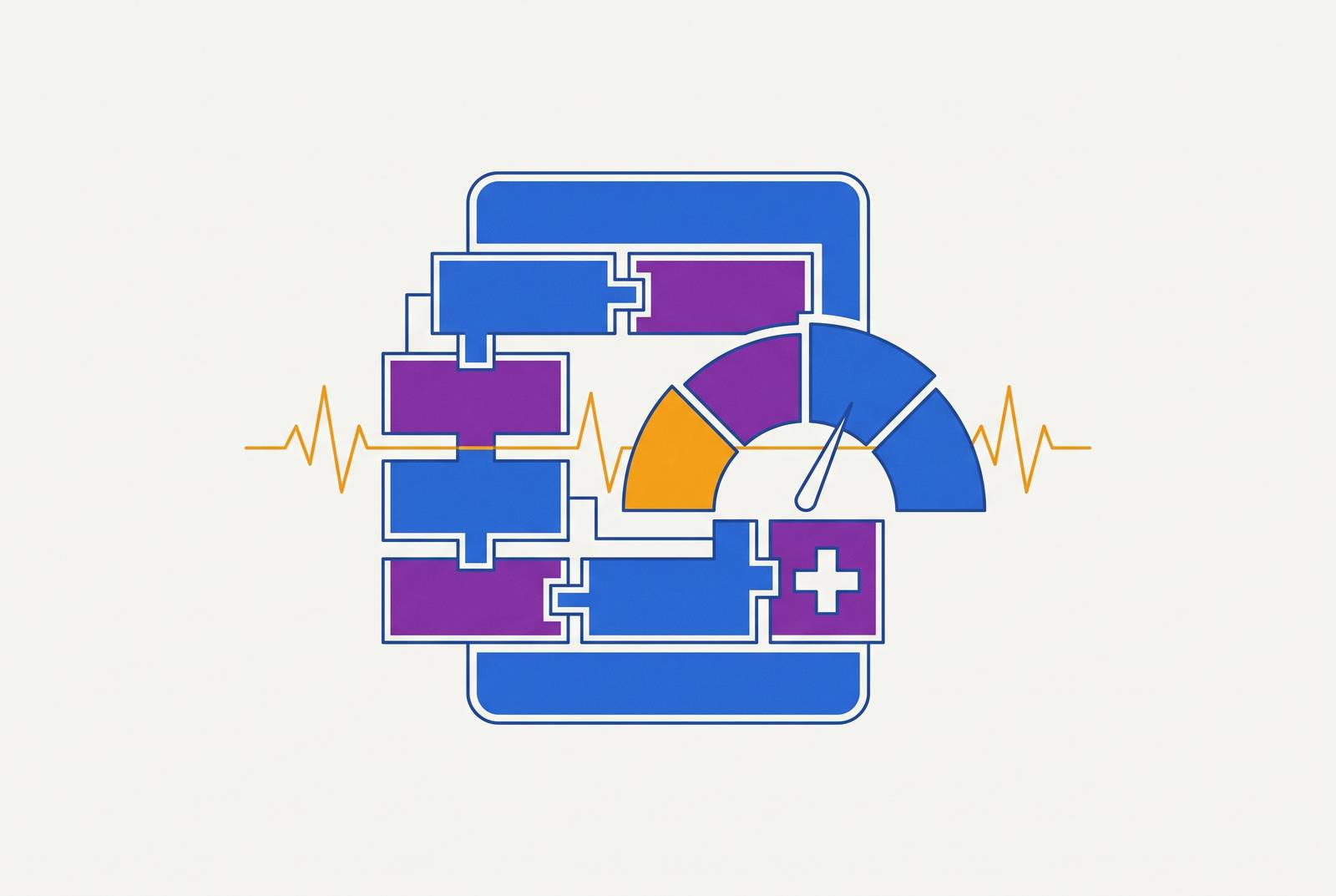
A standard IT service level agreement measures two things: whether a system is available, and how fast it responds to a human-initiated request. An autonomous AI agent running healthcare administration fails in neither of those ways. Its failures are errors of execution across multiple systems, and they surface only when a downstream consequence makes them visible.
An uptime guarantee tells an operator nothing about whether a prior authorization was submitted correctly, whether a denial appeal captured the right clinical evidence, or whether a scheduling agent confirmed a slot that no longer existed. The failure mode is invisible at the moment it occurs. It becomes visible when a payer rejects the request, when a claim is denied, or when a patient arrives for an appointment that does not exist.
The architectural reality sharpens this problem. Computer-use agents navigate payer portals, EHRs, and third-party software by reading screens and interacting with systems the way a human staff member would. The "system" being measured is not one API endpoint whose availability can be expressed as a percentage. It is a chain of UI interactions across platforms the vendor does not control, any one of which can fail silently. A standard SLA is built to measure a single system under the vendor's control. That is not what an AI agent is.
What makes healthcare AI agent contracts structurally different from both standard IT SLAs and earlier healthcare vendor agreements
Three properties separate AI agent contracts from every template that came before them. Each property forces a different kind of contractual response, and none of them appears in standard IT SLAs or in the healthcare vendor agreements that hospitals and physician groups have signed for decades. The first property is autonomous multi-system action. A SaaS tool does what a human tells it to do. The human remains the responsible party for what happens next. The question is whether the agent completed the workflow correctly across every system it touched.
The second property is PHI in motion. A traditional healthcare vendor stores patient data, and the BAA governs that storage. An AI agent reads patient data, transmits it across payer portals and EHRs in real time, and acts on it. Every action is a potential HIPAA event. The BAA and breach notification clauses need to reflect active data handling, not passive custody.
The third property is model drift. AI vendor compliance guidance identifies model drift, a decline in AI performance over time due to outdated data, as a contract-specific risk that requires retraining and update schedules. A model's performance does.
How to define workflow-specific performance metrics instead of relying on uptime and response time
An AI agent SLA must specify what a successful completed workflow looks like for each task the agent runs, with measurable thresholds tied to that outcome rather than to system availability. You need to rebuild performance measurement around the administrative workflows healthcare agents actually execute. For prior authorization, the operative metrics are outcome-based. First-pass submission accuracy measures the percentage of PA requests submitted without a form error or missing attachment that requires human correction before the payer processes it. Status capture completeness asks whether the agent returned a payer decision or status update for every submitted request within the payer's mandated response window. A request that disappears into a portal after submission is a workflow failure, not an outage.
For claims and denial management, claim build accuracy measures correct CPT, ICD-10, and modifier assignment against the encounter, evaluated against adjudication outcomes rather than submission acceptance. Denial classification accuracy tests whether the agent correctly identifies the denial reason before drafting an appeal. A misclassified denial that triggers the wrong appeal letter is an agent error, not an incident. Appeal completion rate tracks the percentage of identified denials that reach a submitted appeal within a defined window.
For scheduling, the metrics target patient safety directly. Slot confirmation accuracy requires the agent never to confirm an appointment against an unavailable slot. Cancellation recovery rate measures how many same-day cancellations the agent successfully refills from a waitlist within the practice's defined recovery window.
The contract mechanism follows from these metrics. Each workflow type should carry its own performance schedule as an exhibit, with defined measurement periods, acceptable thresholds, and remediation triggers. A single uptime SLA cannot serve prior authorization, claims, and scheduling simultaneously. They fail in different ways, and the contract must measure each one.
The BAA provisions that standard templates do not cover when the vendor's agent is actively handling PHI across systems
A BAA written for a passive data processor does not cover the HIPAA obligations created when an agent reads a patient record, extracts clinical data, and submits it to a payer portal. The permitted uses, subcontractor chain, and breach triggers all require explicit renegotiation, because the agent is not storing PHI. It is moving it.
Morgan Lewis guidance establishes that the BAA must explicitly permit the specific upstream and downstream data flows and access in the AI operating environment. Generic language covering "uses on behalf of the covered entity" is insufficient when an agent is reading a signed clinical note to extract codes, transmitting that extraction to a clearinghouse, and logging a screenshot for audit purposes. Each of those actions is a distinct PHI event that the BAA must name.
The model training prohibition is a separate and non-negotiable provision. The BAA must explicitly prohibit the vendor from using PHI to train or improve its general-purpose models. The BAA must say so.
The subcontractor chain requires the same explicitness. AI vendor compliance guidance requires BAAs to compel the primary vendor to flow the same PHI protection standards down to every subcontractor, and recommends that BAAs include the covered entity's right to audit that chain. An agent's PHI handling is only as protected as the least-protected service in its dependency chain.
Breach notification clauses must be tightened and redefined for AI agent-specific incident types
The definition of a reportable incident must expand to cover failure modes unique to autonomous agents, and the notification windows must reflect the operational reality of a system acting at scale without human mediation. Sirion's healthcare SLA guidance establishes real-time access log monitoring and suspicious access pattern detection as automated alert triggers. An agent that accessed a patient record it had no workflow reason to access has created a reportable event, even if no data left the system. The breach clause must treat that access as an incident, not wait for evidence of exfiltration.
Security incident acknowledgment operates on a tighter clock. Sirion's healthcare SLA guidance targets a four-hour acknowledgment window for security incidents, and this applies to detection of unauthorized access to systems the agent is operating, not just the vendor's own infrastructure. A vendor that acknowledges a suspected access event in four hours gives the covered entity room to assess its own regulatory timeline. A vendor that treats the agent's activity as outside the scope of its security obligations gives the covered entity nothing.
The contract must therefore redefine "breach" in agent-specific terms. A misrouted PHI transmission, a screenshot logged without authorization, and an agent accessing a record outside its assigned workflow are each reportable events with their own clocks. The standard language, written for a database sitting in a vendor's data center, does not anticipate any of them.
Human oversight provisions: what the contract must require when the agent makes a mistake or reaches a decision boundary
A healthcare AI agent contract must define the conditions under which the agent stops and escalates to a human. This is not a general statement about human review. It is a contractually specified confidence threshold, exception category, or regulatory trigger, and it must be written into the agreement at the level of operational detail.
The regulatory pressure is already tangible. State-level law has begun writing human oversight requirements into the compliance baseline for healthcare utilization decisions, and contracts must reflect these jurisdiction-specific requirements rather than relying on the vendor to track them independently. A vendor's general claim that "humans remain in the loop" will not satisfy the regulatory language that is now emerging, and the covered entity is the accountable party when the loop breaks.
The escalation provisions must specify three things precisely. The contract must specify the maximum time the agent may hold a workflow pending human review before it flags and escalates to a supervisor queue. A workflow that sits waiting is not a resolved workflow. And the contract must define how human review decisions are captured and fed back into agent logging for audit purposes.
The "hybrid intelligence" model is the operational architecture mature AI agent deployments treat as the baseline, and the contract should reflect it. Contracts should specify this division of responsibility explicitly. Leaving it to implementation documentation makes oversight a project decision rather than a contractual obligation, which means it can be quietly de-scoped when the vendor's implementation team feels pressure to move faster.
Model drift and ongoing performance accountability: the contract obligations that begin after go-live
If a healthcare AI agent contract lacks explicit model monitoring, drift remediation, and update schedule obligations, the covered entity has no contractual recourse when performance quietly degrades after deployment. The most important SLA provisions are not the launch-day terms. They are the mechanisms that govern what happens as the model changes over time.
Incident response is reactive: something failed, and the contract says what happens next. AI vendor compliance guidance identifies model drift, a decline in AI performance over time due to outdated data, as a specific SLA risk. The contract must include the vendor's commitment to monitor accuracy, fairness, and safety metrics with defined thresholds, and to remediate within an agreed timeframe if performance degrades below them.
Monitoring obligations must specify measurement frequency, reporting cadence, and bias audit schedules. AI vendor compliance guidance identifies quarterly bias audits as the standard, and contracts should name the demographic dimensions being monitored. A bias audit that does not name its dimensions is not an audit.
The retraining obligation must be operationally defined. A vendor that claims a model was "updated" without a defined methodology has not met an obligation. It has made an assertion. Independent validation rights follow from this. The covered entity cannot verify what it never had the right to inspect.
Certification maintenance is the minimum standard the contract treats as automatic. Vendors should be required to maintain active SOC 2 Type II certification and demonstrate ongoing compliance. This is not a differentiator. It is the floor, and the contract should treat its lapse as a termination trigger rather than a discussion item.
Remediation and termination rights: what the contract must give the covered entity when a vendor misses its obligations
Every performance, data governance, breach notification, oversight, and model accountability obligation in the contract must be paired with a specific, pre-agreed remedy. Without pre-negotiated remediation and exit rights, the rest of the contract is advisory. Performance failures carry financial remedies tied to the affected workflow. Service credits for missed workflow-specific SLAs should be calculated against the affected workflow's contracted volume, not a flat fee. A vendor that missed its prior authorization accuracy threshold for a quarter should not pay the same credit as one that missed its scheduling threshold for a week, because the value at risk is different. Unpaid contract extensions provide a second remedy for periods during which performance fell below threshold. The covered entity should not pay full price for a model that was underperforming.
Data and breach failures require sharper consequences. Notification failures, such as missing the 24-hour initial report window, should carry automatic financial penalties rather than a cure period, because the covered entity's downstream reporting obligations to regulators are time-bound and cannot wait for the vendor to respond. PHI misuse, including unauthorized model training, should be treated as a material breach with immediate termination rights and data destruction obligations. A vendor that built its model on patient data it should not have used has forfeited the relationship.
Enforcement depends on transparency. Sirion's healthcare SLA guidance establishes that automated alert monitoring of SLA clause status, including missing backup notifications, suspicious access patterns, and expired certifications, is the operational mechanism by which covered entities detect breaches in real time. Contracts should require vendors to support, not obstruct, automated monitoring by the covered entity's contract management systems. AI-driven contract monitoring catches obligation failures that manual review misses at scale, and for covered entities managing multiple AI vendor relationships, automated clause monitoring is itself a risk management requirement, not a convenience.
An AI agent that performs well makes all of this invisible. The contract must be built as if performance will need to be enforced, because the covered entity has no leverage after signing that it did not put in the document before. The moment the agent fails, the only tools available are the ones the contract specified in advance.