Introducing AI Automation to Front-Desk and Billing Staff Without Triggering Resistance
Earn staff buy-in by framing AI as relief from repetitive work, not just efficiency.

Introducing AI automation to front-desk and billing staff without triggering resistance is primarily a change management challenge. Staff take up AI faster and with less friction when practices show how it can relieve repetitive work, spell out what people will keep doing, and make those boundaries clear in each day's work. The test is not simply whether the agent performs, but whether staff trust it enough to stop working around it.
Why front-desk and billing staff resist AI — and why the standard rollout makes it worse
Resistance is a predictable response when a rollout leaves staff uncertain about what happens to their jobs. Front-desk and billing employees have concrete reasons for that concern because their visibly repetitive tasks are the same ones being targeted for automation. Prosper AI's 2026 guide identifies job security worries and the difficulty of learning new systems as adoption obstacles. These concerns deserve an operational answer.
The standard rollout makes matters worse when it announces what is being deployed without explaining why. Going live before spelling out what the agent handles and what the human keeps leaves staff less sure of who is responsible for what. Measuring success through metrics staff had no part in choosing then makes the change feel imposed from beginning to end. That friction can extend beyond patient access staff to billing leads, practice managers, and IT change advisory boards with authority to slow the rollout.
What repetitive administrative work actually costs the staff doing it
The existing workload is not a neutral alternative to automation. Eligibility verification, prior authorization, claim status checks, and inbound scheduling calls are among the tasks most associated with administrative burnout and turnover. Their repetition matters because it consumes time that staff could spend on patients and cases requiring judgment. The burden is not simply having too much to do, but having too little room for the parts of the job that feel useful.
Administrative burden is the primary driver of burnout cited by clinicians, and the same dynamic runs through front-desk and billing work. When rote, rule-based tasks dominate meaningful patient interaction, the balance of the job becomes a reason to leave. Replacing a front-desk employee takes a lot of money and effort to recruit and retrain someone, which gives practices a reason to keep the people they have. Automation has a stronger case when it helps the practice keep experienced people by changing what fills their day.
That argument must still leave room for staff who take pride in mastering these workflows. A task that bores one employee may make another feel skilled and valued at work. Prosper AI's 2026 guide describes automation as an AI workforce that does repetitive work so staff can spend time on patients and exceptions that need a person. The goal is to give people the option to stop doing rote work while respecting their mastery of it.
Why "AI as relief" lands better than "AI as efficiency" when talking to the people doing the work
The language used to introduce AI determines whose problem the rollout appears to solve. Leading with faster claims processing or cost savings centers the practice's financial interest. Explaining that an agent will handle hold time and status checks instead centers the employee's afternoon. Practices that lead with work staff already find tedious generate less resistance because the proposed benefit is recognizable before deployment.
An agent answers inbound calls and handles routine scheduling, allowing the person at the desk to spend more time with patients who are physically present. The message emphasizes restoring attention to those patients. It describes a change in the employee's work that can later be tested against experience.
For billing staff, the same framing requires a different division of labor. The agent runs eligibility checks, pursues claim status, and generates initial appeals drafts, while the biller reviews exceptions, handles payer disputes, and applies judgment. This distinction explains both what the system removes and what makes the human role necessary. Staff who understand that division have a reason to work with the system.
The sequence that prevents resistance: what to do before go-live, not after
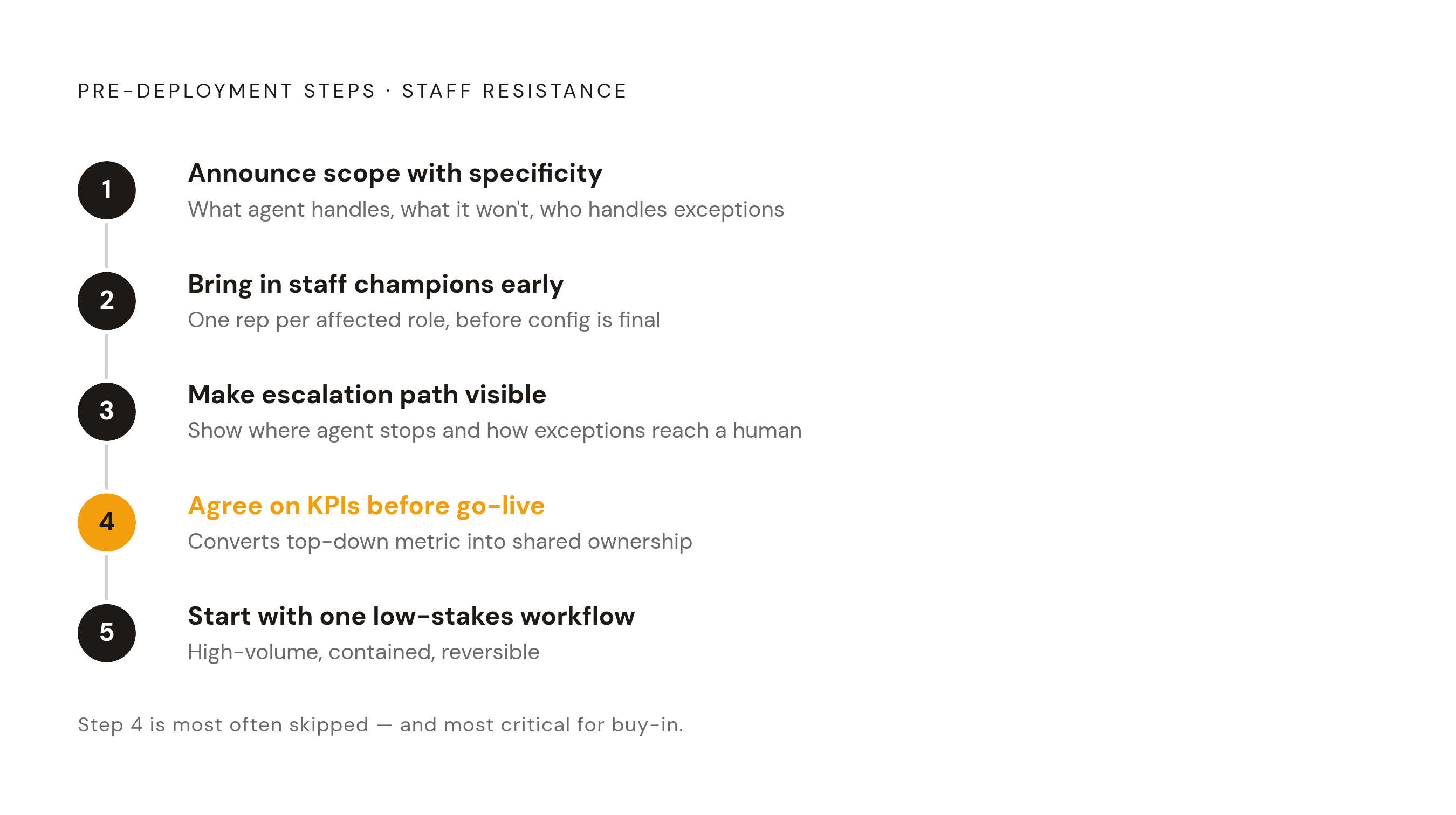
Much resistance crystallizes between the announcement and deployment, while staff are forming expectations about the change. The first step is therefore to announce the scope with specificity. The scope should specify the workflows the agent will handle, the ones it will not touch, and the person staff should approach when something unexpected happens. A vague promise that the system will make work easier leaves the central questions unanswered.
Once that boundary is clear, bring in a staff champion from each role the change will affect before configuration is final. A patient access representative and a billing representative can identify friction in the proposed workflow while there is still time to address it. Their input improves the design and gives peers an advocate who understands the work. These staff champions must have a say in how the workflow works before they are asked to explain the decision to their peers.
The next step is to make the escalation path visible. Staff need to know where the agent stops, how an exception reaches a human, and that human judgment has the final word in those cases. This handoff addresses the fear that the system will mishandle something silently while leaving an employee accountable. With responsibilities settled, leadership and staff can agree on workflow-specific KPIs and how results will be shared.
That agreement belongs before go-live, when staff can still help define success. Metrics chosen together give the people responsible for the workflow a stake in judging the result. Prosper AI's 2026 guide identifies the move from pilot to production as a point where many automation projects stall.
How phased rollout and human-in-the-loop design earn staff trust during the first weeks
Communication establishes the promise, but staff belief in it depends on deployment design. Start with one high-volume, low-stakes workflow and give staff the explicit role of exception reviewer. Keeping the scope small lets people see how the agent works before they are asked to trust it with several tasks. It also makes the division between routine work and human judgment easier to see.
Human-in-the-loop design makes that division practical by escalating exceptions for human resolution. During the first weeks, staff can see that they have not been removed from the process. They have moved to the point where the process needs their judgment. A visible handoff is more persuasive than reassurance because it demonstrates where the system's authority ends.
For that handoff to be useful, the agent must show why a case needs review. When a billing agent flags a claim, staff need to see what it found and what it cannot resolve. Without that detail, staff may have to do the original work all over again to review the exception. When the agent explains its findings, staff can use their judgment with less wasted effort and feel relief early on.
Prosper AI's 2026 guide documents Arkansas Pediatrics as an example of workload relief after deployment. The majority of inbound calls were handled end to end without staff involvement, freeing over 120 staff hours a month. The guide also reports that callers stopped abandoning calls at peak times.
Where billing team resistance is different from front-desk resistance — and why it needs a separate answer
Billing resistance is less about job security than about professional authority. Experienced billers and coders have developed knowledge of payer rules, denial patterns, and appeal strategy over years. They may worry that an automated system will make credentialing, coding, and appeals decisions that their expertise should govern. Being left to approve outputs they did not generate can feel like irrelevance.
Pulling claim status, generating appeal drafts from templates, and running eligibility against payer portals can sit with the agent. Exception logic and payer relationship strategy remain with the biller.
The relationship between upstream errors and downstream denials strengthens this argument. KFF's 2026 analysis of CMS Transparency in Coverage data identifies administrative reasons as the largest named category of in-network claim denials, substantially exceeding medical necessity denials. A significant share originates in front-desk workflows, including registration and eligibility errors. Coding errors are also a large source of denials.
Reducing upstream errors allows experienced billing staff to direct more attention toward exceptions, payer disputes, and appeals that require their judgment. The relevant promise is that expert work becomes more frequent and more consequential. A single message about fewer phone calls cannot fully answer this group's concern about who governs the work.
What "going live in weeks" actually requires from practice leadership — and where that expectation breaks down
Fast deployment is achievable, but leadership must resolve several prerequisites rather than leave them to emerge during configuration. Compliance comes first. Any AI tool that processes, stores, or transmits PHI must be covered by a signed Business Associate Agreement. The vendor must also meet the same encryption, access control, and audit logging standards as other systems handling protected health information.
Before vendor engagement begins, leadership must designate one internal point of contact with authority to approve workflow configurations. Agents that work like staff need to know whose instructions to follow. When two stakeholders give conflicting directions, configuration stalls regardless of how quickly the technology could be deployed.
Before choosing a vendor, leaders must also find out whether the deployment model needs an API integration or an EHR workflow overhaul. Discovering unplanned infrastructure requirements mid-engagement is a reason pilots stall before production. Prosper AI's 2026 guide identifies integration with legacy EHR and billing systems as one of the three most common challenges. Computer-use agents avoid that dependency by reading screens, clicking, and typing in existing systems as a staff member would. They do not require the EHR vendor's integration roadmap or a change to existing systems, which compresses the timeline.
The remaining decision is to choose one initial workflow and hold that scope through deployment. Trying to automate scheduling, eligibility, and prior authorization simultaneously introduces the disruption and confusion that produce resistance. Expanding scope also undermines the narrow, observable trial through which staff are supposed to build trust.
How to know adoption is working — and what to watch in the first ninety days
The clearest sign of adoption is that staff use the agent's exception queue to handle tasks they would otherwise do manually. That behavior distinguishes trust from compliance because it shows that employees accept the agent's part in the workflow. Persistent rework, by contrast, means the practice has not yet established that confidence.
The KPIs agreed before go-live provide the right frame for interpreting this behavior. Universal promises about hours saved across all roles create accountability mismatches because different workflows produce different benefits. Measures should instead map to the automated process and remain visible to the staff responsible for it.
For front-desk automation, the early measures to watch include inbound call handling rate, peak-time abandonment, and eligibility error rate on submitted claims. These measures connect the deployment to call pressure and avoidable administrative errors. For billing automation, the relevant signals include first-pass clean claim rate, days in accounts receivable for the automated workflow, and the proportion of denials that reach appeal. When fewer upstream errors allow more attention to appeals, billing staff can see how automation increases the value of their expertise.
At the end of the first ninety days, leadership should judge those results together with staff behavior. Even when the system works well, employees who still work around it have yet to take it up.