Defining New Staff Roles After Administrative Workflow Automation
Automation shifts routine work to agents, leaving staff to handle exceptions and governance.

Administrative workflow automation changes both the work that staff must do and the volume they handle. To get its full value, practice administrators need to set out new roles for exceptions, oversight, governance, and patient escalation. Deliberate role redesign gives the remaining human work clear ownership and turns staff judgment into a means of improving the automated workflow.
Why automating administrative workflows forces a role redesign, not just a headcount question
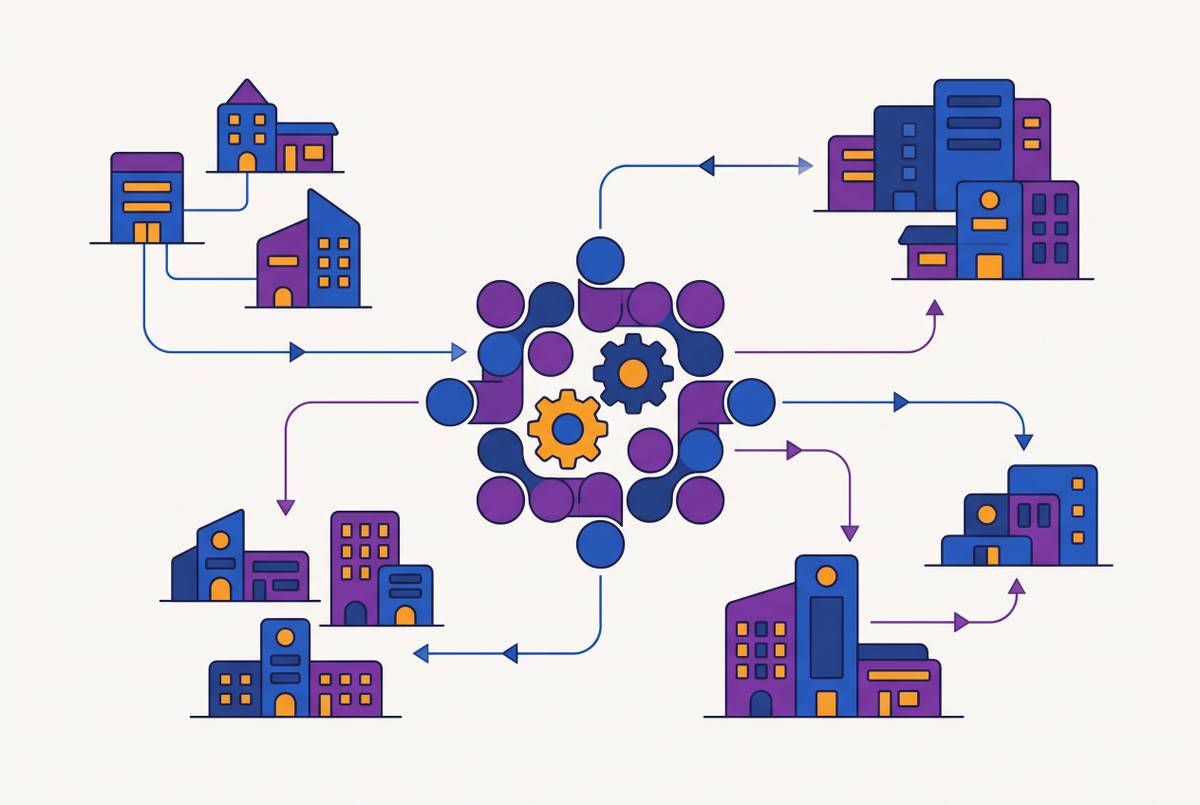
Payers now deploy systems that review and approve or deny claims at a speed and scale that manual provider workflows cannot approach. That asymmetry puts structural pressure on practices to change how administrative work gets done. Computer-use agents (CUAs) absorb procedural work by operating software as a staff member does, reading screens, clicking, typing, and navigating. Agents can thus take on whole sequences of work that once made up a job, as well as single tasks.
Yet absorbing those sequences does not remove the need for judgment. HealthAdminBench shows that doing subtasks well falls short of reliably completing work end-to-end, which helps explain why people still need to handle complex, edge, and policy-sensitive cases. As routine volume moves to agents, those cases become a larger part of the human workload. Leaders need to decide how to use the capacity that returns as the old allocation of tasks changes. Without explicit redesign, a practice can automate its routine work while leaving its hardest decisions without a clear owner.
What automated agents actually take over in a typical administrative workflow
The work best suited to end-to-end automation has three traits: high volume, logic that repeats, and steps that move across multiple systems. They include prior authorization submission, insurance verification, scheduling queue management, claim validation, and denial queue routing. Prior authorization provides a clear before-and-after picture. Staff once extracted clinical data from a chart, matched it against payer criteria, and submitted it through a portal. A computer-use agent can carry out those deterministic steps without API integration, so staff can shift from routine submission to cases they need to interpret.
The same shift takes place in scheduling and referral intake. Agents can use data already in the EHR to pre-populate forms, verify insurance, flag fields that are missing, and route cases. These activities consume staff time in proportion to patient volume. OS-Marathon examines vast-horizon, repetitive tasks whose recurring sub-workflows follow learnable logic, the structure also found in processing prior authorization requests, working denial queues, and reconciling referral data. The practical change for a billing specialist, referral coordinator, or authorization clerk is that much of the repeated processing moves to the agent, while ambiguous cases and cross-system discrepancies remain.
What automation does not replace: the exception queue as the new front line
The remaining work is a defined category of cases in which payer rules are ambiguous, documentation conflicts with clinical context, a denial requires policy interpretation, or a patient’s situation falls outside the standard workflow. Routing uncertain cases to a human queue is a control. The cost of an autonomous error in a prior authorization denial or claim appeal makes that boundary important.
State regulation reinforces the need to distinguish automated processing from decisions that require human authority. Texas passed a law in 2025 prohibiting utilization review agents from using automated decision systems to make, wholly or partly, an adverse determination, and requiring that only a physician or licensed health care provider may determine medical necessity. Arizona adopted a prohibition on AI as the sole basis for a medical necessity denial through HB 2175, in force July 1, 2026. Maryland enacted a flat ban prohibiting AI from denying, delaying, or modifying health care services through HB 820, in force October 1, 2025. To handle exceptions under these rules, staff need to understand payer policy, read the clinical context, judge when to escalate, and keep careful documentation. Handling exceptions needs a role defined around those demands.
The new role architecture: four positions that emerge from post-automation operations
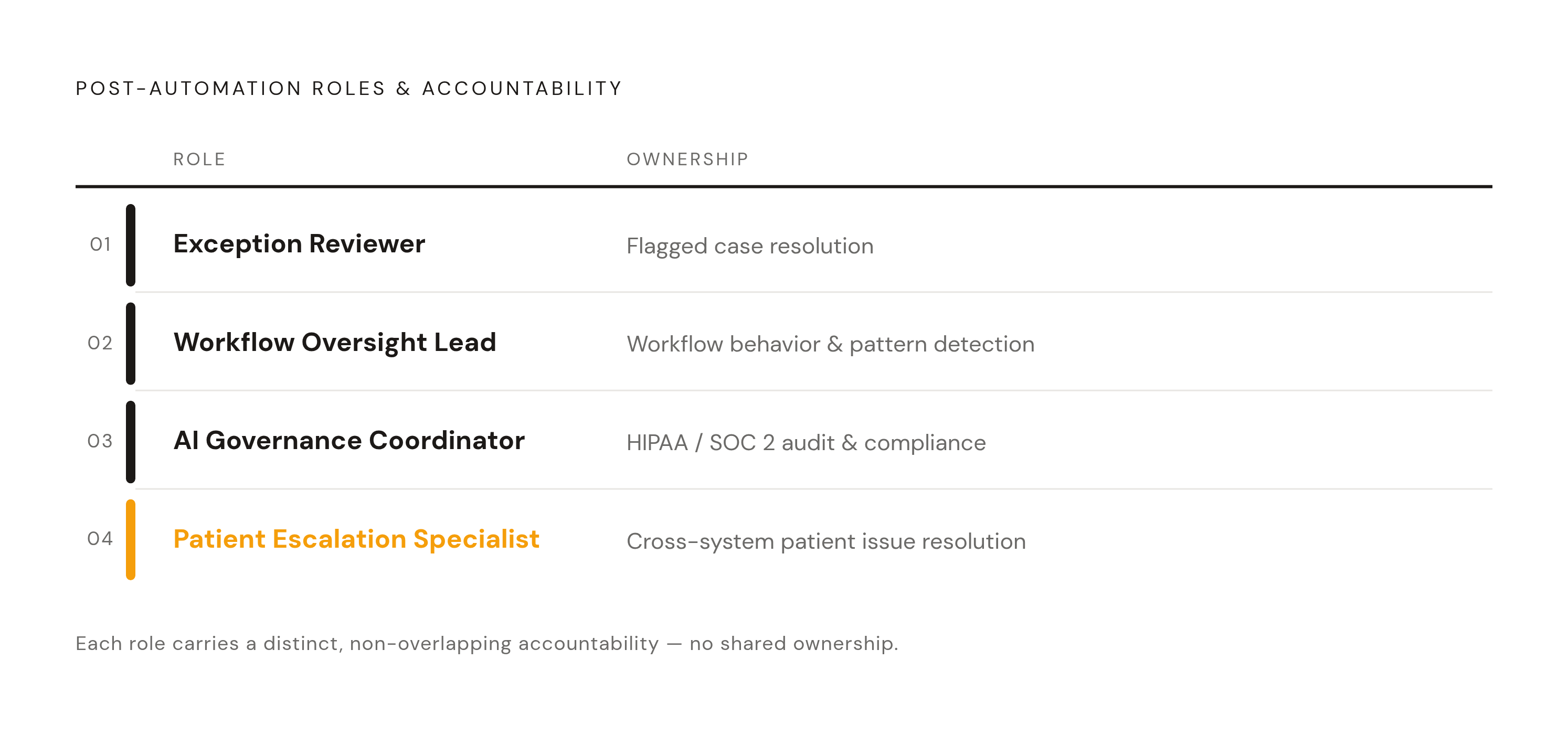
Four functions provide a practical framework for post-automation operations, namely exception reviewer, workflow oversight lead, AI governance coordinator, and patient escalation specialist. They are not a rigid organization chart, but each needs an explicit owner. The exception reviewer owns flagged cases, including prior authorization requests with conflicting documentation, denials requiring narrative appeals, and referrals with insurance discrepancies. This person gathers documentation, applies payer-specific policy knowledge, drafts appeals, and records the outcome in the agent system. The role replaces general processing with case resolution and requires experience.
The workflow oversight lead replaces supervision centered on processing volume with accountability for workflow behavior. This person monitors where exceptions cluster, identifies patterns that suggest a rule needs updating, and connects staff corrections to workflow configuration. The lead does not configure AI directly, but must recognize when automation drifts from its intended behavior. In multi-location operations, that responsibility may sit at the group level.
The AI governance coordinator owns HIPAA and SOC 2 compliance as it applies to agent activity. The work includes audit trail review, access control verification, PHI handling documentation, and vendor certification tracking. Shadow AI, which is staff use of AI tools outside approved workflows, leaves work outside governance that this role must bring under review. Smaller practices may combine it with an existing compliance function, but assigning it by default to the workflow oversight lead risks a conflict between operational performance and compliance integrity.
The patient escalation specialist handles the human consequences of automated scheduling, referrals, and authorization status workflows. This person explains what happened, corrects errors that crossed systems, and manages the patient relationship through resolution. The role differs from a call center position because communication depends on understanding the workflow as well as the patient’s concern. It replaces routine patient-facing processing with responsibility for difficult interactions. Eliminating that function leaves patients without appropriate support at the seams of the automated process.
The skills these roles require and why they differ from what most current staff hold
These positions require a different capability profile from routine administrative processing, and most current staff will need deliberate development. Deep payer policy literacy means understanding which criterion triggered a denial, whether it is contestable, and what documentation could reverse it. That knowledge may previously have been distributed across a processing team. Exception reviewers need it to resolve cases, while oversight leads need it to understand recurring problems. Administrators cannot assume that staff know this much just because they have submitted requests before.
Workflow pattern recognition adds a separate analytical demand. Staff must distinguish an isolated discrepancy from exceptions clustering around a payer, procedure code, or documentation gap. AI system fluency then allows oversight and governance staff to describe departures from intended behavior in terms that support correction. This requires an understanding of how agent workflows are structured. Training and hiring should take this difference into account, with technical familiarity treated as a needed skill that falls short of expertise in configuration.
Patient escalation specialists need emotional intelligence and system knowledge at the same time. They must explain an automated process, acknowledge an agent error, and maintain the patient relationship while the issue is resolved. Everyone who works with agents that handle PHI must make HIPAA and audit discipline part of their daily habits. Staff need to understand compliant audit trails, practical access controls, and when to escalate a potential exposure. Administrators can use this list of skills to assess what staff do well and where they need to learn more.
How to run the transition: a sequenced approach for practice administrators
Map the workflow before reassigning anyone. Document which tasks are being automated, their volume, and where exceptions surface. That baseline shows what work remains and which skills it will require. It also establishes the workflow-specific measures for the transition, including exception resolution time, appeal success rate, authorization turnaround, and patient escalation close rate.
Next, find the staff members who already handle hard cases, payer escalations, and unusual situations. They are natural candidates for exception review and oversight because they already hold relevant judgment. As agents are deployed, keep staff working with them while they still have their previous duties. Parallel operations build familiarity with what agents handle and reveal real exception patterns before the old workflow is withdrawn. Those patterns provide a firmer basis for role assignments than assumptions made before deployment.
Someone must be put in charge of governance before agents go live, before a problem in parallel operations prompts the practice to act. Audit trail review, access log checks, and vendor certification status need an accountable owner from the start. The Governing AI Agents analysis names information asymmetry, discretionary authority, and loyalty as key challenges in governance and notes that the usual ways of monitoring may fail with AI agents. Clear accountability therefore cannot depend on someone informally watching the system. At the same time, build a process for capturing staff corrections and routing them into workflow configuration, so that resolving an error also supports improvement.
What role redesign looks like at different practice sizes and structures
Independent and small group practices may place several functions with one or two staff members. One person may combine exception review with patient escalation, while the practice manager takes governance oversight. The constraint is not the absence of four separate positions, but the concentration of knowledge in very few people. If the person handling exceptions leaves without a documented process, the practice loses its means of resolving difficult cases.
Mid-market multi-location groups have enough work to support staff whose job is to serve as an exception reviewer for the group. Workflow oversight can sit above individual sites, where it can spot patterns across locations and look at each site’s exceptions as part of the whole. Governance also becomes more demanding as more staff and sites interact with agent systems. Compared with a small practice, the role design separates case resolution from cross-site oversight more clearly. It must also give the growing scope of HIPAA exposure a defined owner.
In PE-backed portfolios, portfolios managed by management services organizations, and enterprise health systems, each function can have a team of its own. Workflow oversight may be shared, with staff at each site responsible for how it performs and staff at the portfolio level responsible for consistency and compliance. The governance coordinator may work with legal, IT security, and external auditors, making governance a substantive role. Teams that handle exception review from a central location can take on denial appeals and prior authorization escalations for sites across the group. That is an efficiency portfolio-level automation enables, but it requires deliberate structure rather than simply extending each practice’s old staffing model.
The measure of whether role redesign is working
Role redesign succeeds when the new positions produce better workflow outcomes than the old staffing model. Reviews should use the measures set before the transition in place of a generic productivity target. Exception reviewers should be assessed on resolution rate, appeal success rate, and time-to-close on flagged cases. Total cases processed belongs to the automated agent’s performance assessment. Authorization turnaround and patient escalation close rate keep the assessment tied to the workflows and patient-facing work the redesign is meant to improve.
Workflow oversight leads should be evaluated on whether they detect and address exception clustering before it affects revenue. The existence of exceptions is expected, so their absence is not a sound measure of oversight. Governance coordinators require prospective tracking of complete audit trails, clean access logs, and maintained compliance certifications rather than a retrospective assessment after a crisis. These measures distinguish active control from the mere absence of a reported problem. They also make accountability visible without confusing operational speed with compliance integrity.
The final test is whether human expertise improves the automated system over time. When exception reviewers record what happened and oversight leads feed corrections into workflow configuration, the work of resolving cases helps the system perform better. Staff learn more about difficult cases, and what they learn shapes how the workflow handles the work that follows. Automation performance and human role performance can then improve together.