Vendor Capability Tiers for Healthcare AI That Operates Software Like a Credentialed Staff Member
A framework separates software automation from staff-level workflow ownership in healthcare AI.

Computer-using AI agents can automate healthcare administrative workflows without API integrations by reading screens, clicking, and typing across EHRs and payer portals. But navigating software is not the same as owning a workflow. A four-tier capability framework separates bounded assistance from end-to-end execution and judgment, giving practice administrators a way to evaluate whether an agent actually operates like a credentialed staff member.
Why "operates software like a staff member" is not a binary claim
“Operates software like a credentialed staff member” compresses several different capabilities into one claim. A vendor may mean that its agent fills out a form, follows a fixed sequence, or manages an authorization through resolution. Those are different levels of operational responsibility. A staff member executes clicks, sustains a judgment loop across systems, catches exceptions, and knows when to escalate.
OSWorld-Human finds that even the best computer-use agents take 2.7–4.3× more steps than they need to. Planning calls alone account for more than half, sometimes close to three-quarters, of total task latency. Tasks that take people minutes can take agents tens of minutes. An agent that takes too long to finish a real-time eligibility check or same-day authorization can fall short of the staff-member standard even when it gets the right result.
What a credentialed staff member actually does that most automation never reaches
The benchmark is the full behavioral profile of a trained administrative staff member. That begins with interpreting screens across an EHR, payer portal, fax queue, and scheduling platform without a shared API or data schema. It also requires remembering what has already happened across sessions, logins, and days. Submitting a prior authorization starts an obligation. Following up requires retaining its context and knowing which action depends on the payer’s response.
That continuity must survive a changed form layout, two-factor authentication prompt, or denial requiring peer-to-peer review, each of which calls for a different response. Payer-specific and practice-specific rules further constrain those responses, including the format and portal section required for clinical attachments. Generic attachment logic is not enough here. When the workflow reaches a decision that needs a human, the handoff must include enough context for that person to act.
Compliance is inseparable from this operational standard. A staff member who handles PHI works under HIPAA’s minimum-necessary standard, leaves a trail of what they do, and knows which decisions need a human. An agent must make that accountability explicit. Correct execution without an audit log, or forwarding PHI to a sub-vendor without a BAA, fails the standard even when task accuracy is high.
The three architectural choices that determine where a vendor's ceiling is
The first architectural choice is how the agent interacts with software. API-only integrations or integrations based on healthcare data exchange standards reach standardized transactions but leave gaps where payers lack APIs or workflows require unsupported attachments, fields, or appeals. Static RPA scripts can navigate portals, but depend on stable field labels, button positions, and session flows. Screen-reading computer-use agents instead use screenshots, cursor actions, clicks, and typing, so they can work without an underlying API or data schema. Interface access sets the system’s practical reach.
The second choice is how the agent preserves state. An agent may get each action right but lose the thread between submission, follow-up, and resolution. This distinction is especially consequential for prior authorization follow-up, denial appeals, and referral intake. Each workflow has work still owed and next steps that depend on what happens. Without persistent state, strong local execution cannot reliably become complete workflow ownership.
The third choice is how compliance constrains the system. HIPAA alignment and SOC 2 Type II shape which sub-vendors can touch PHI, how actions are logged, when confidence thresholds trigger human review, and how concurrent sessions remain isolated. Every PHI-handling sub-vendor in the processing chain needs signed BAA coverage, including the model provider, browser automation layer, and vector or session store where applicable. A gap compromises the whole processing chain. HITRUST certification is also increasingly expected for payer-facing tools beyond the HIPAA baseline.
A four-tier framework for evaluating what a vendor's agent can actually do
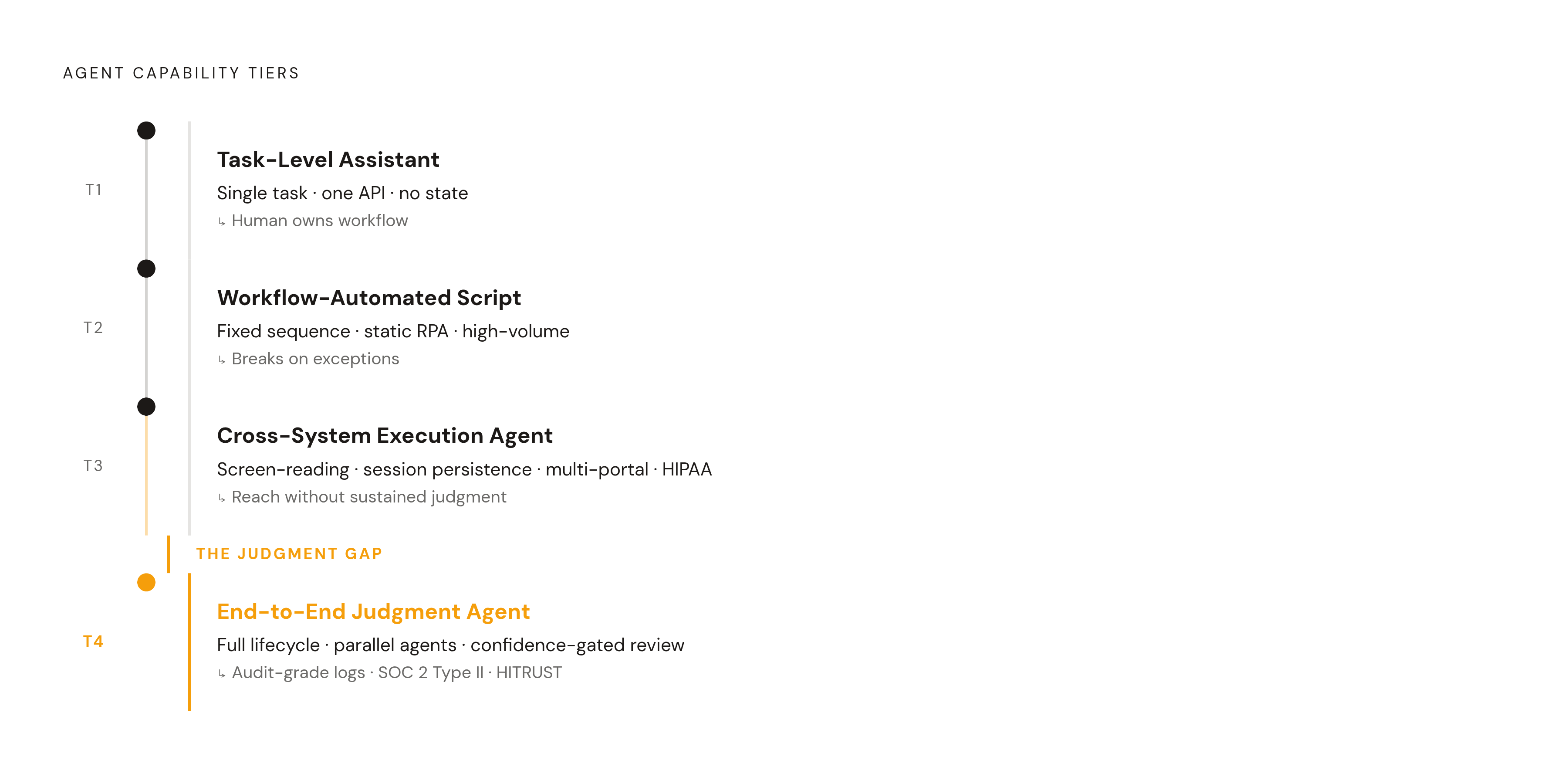
Tier 1 has task-level assistants that do a set task when asked, such as drafting a prior authorization form, looking up eligibility, or writing a clinical note. They typically connect to one system through an API, lack persistent workflow state, and depend on human prompting between steps. The staff member still owns the workflow. Their best fit is assistance within that arrangement, although PHI chain of custody can become unclear when outputs leave the connected system.
Tier 2 has workflow-automated scripts that follow a set sequence when the environment stays the same. A standard prior authorization submission to a specific payer portal or charge posting to a specific EHR field fits this tier. Static RPA and narrow API integrations serve high-volume, low-variability transactions well. RPA paths need upkeep when interfaces change, while API-only paths stop where API coverage ends, and neither can handle exceptions in general.
Tier 3 consists of cross-system execution agents that use screen-reading, session persistence, multi-portal coverage, concurrent request handling, and a HIPAA-aligned PHI posture. They can submit, follow up, retrieve status, and escalate across an EHR, payer portal, and fax queue within a sustained session. They fit best when they take over defined cross-system work from staff in prior authorization, referral intake, scheduling, and denial management. New payer policies, requests for peer-to-peer review, and appeals that need a clinical argument must have paths for escalation to a human.
Tier 4 consists of end-to-end judgment agents that maintain the complete workflow lifecycle, including state, exceptions, contextual escalation, and audit-grade logging. Their architecture adds agents that work together on tasks in parallel, human review based on confidence, and configuration that turns the staff’s existing protocols into agent logic. The compliance standard includes minimum-necessary access, full sub-vendor BAA coverage, SOC 2 Type II, and HITRUST where payer-facing. Deployment is part of this tier’s test. Operational sophistication does not establish staff-member equivalence if implementation requires months of custom integration rather than configuration of the practice’s existing work.
Where payer portal coverage separates Tier 2 from Tier 3 in practice
Payer portal coverage exposes interaction, state, and exception-handling limits at once. CMS-0057-F applies its standards-based prior authorization API requirements to Medicare Advantage, state Medicaid and CHIP fee-for-service programs, Medicaid managed care organizations, CHIP managed care entities, and QHP issuers on the federally facilitated exchanges. API compliance dates begin January 2027. That scope is not universal payer coverage. Commercial employer plans and many regional payers remain outside it, and some have no API at all.
For a practice, the relevant comparison is therefore its payer mix against the vendor’s actual submission paths. API aggregators handle standard HIPAA transactions but cannot manage the clinical attachment uploads, payer-specific form fields, and appeals described in this coverage gap. An offering limited to a healthcare data exchange standard does not become cross-system merely because it covers standardized transactions well. The work left uncovered still needs another way to get done. For many specialty practices, that portion represents a majority of volume.
Screen-reading supplies a way to navigate browser-based payer portals without API setup, including interfaces with dynamic fields, session timeouts, and two-factor authentication prompts. Kore.ai describes an end-to-end ownership model in which agents take work across systems and beyond one system’s API boundary through resolution. A single-threaded agent submitting one authorization at a time does not meet high-volume practices’ concurrency needs. The urgency is asymmetric because when payers automate denial generation faster than providers automate submission and appeal, the slower party absorbs the cost.
Where Tier 3 agents still fall short and what moves a vendor to Tier 4
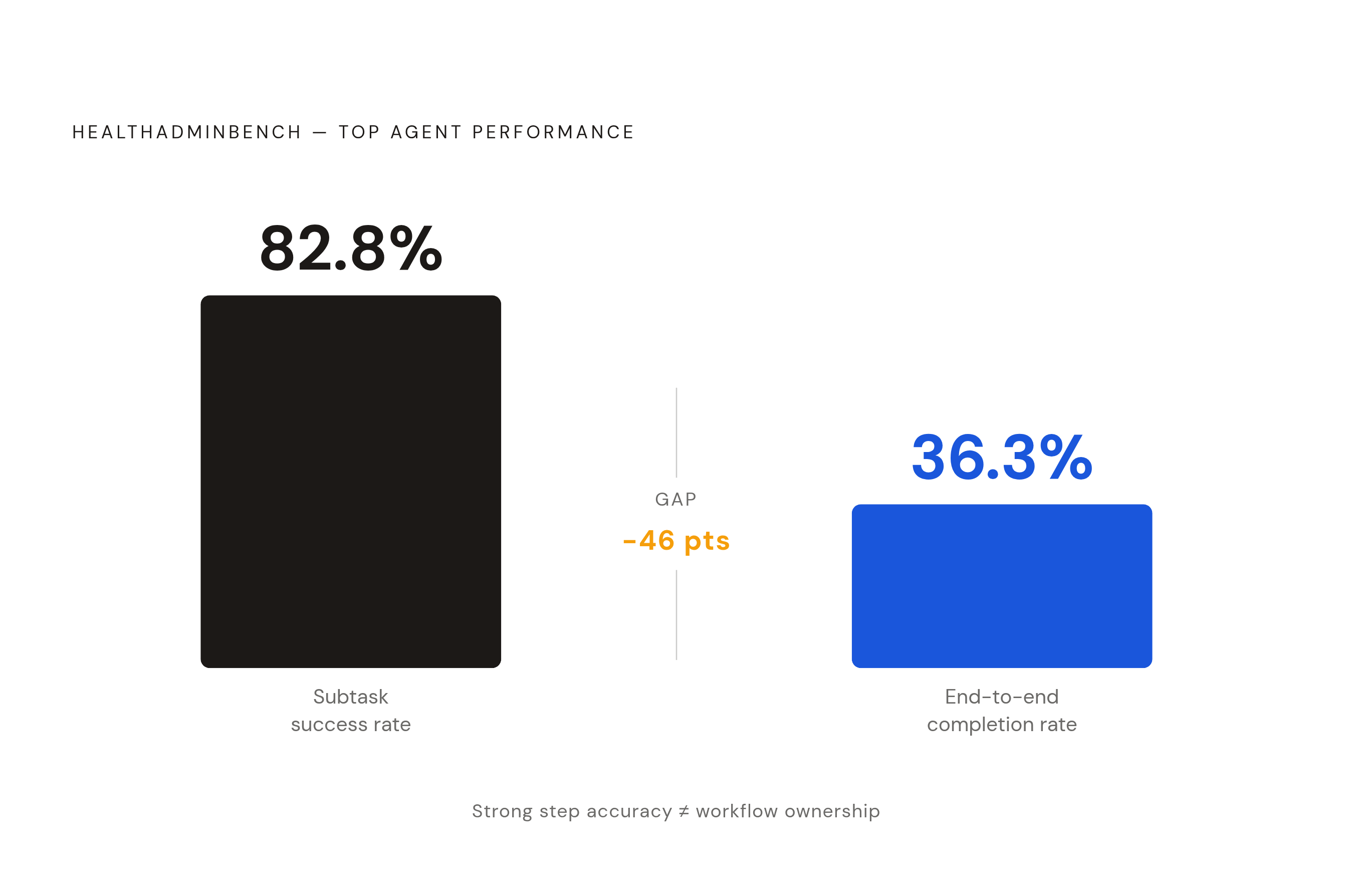
Cross-system reach does not establish sustained judgment outside a defined workflow. HealthAdminBench finds that its best-performing agent achieves only 36.3% end-to-end task success, despite stronger performance on individual administrative actions. This gap is visible in agents’ document handling, work across portals, and state tracking over many steps. The steps can succeed while the workflow fails. The benchmark establishes why subtask accuracy cannot prove workflow ownership.
A prior authorization denial that needs peer-to-peer review shows the difference. A Tier 3 agent may finish submission but miss that the denial is an escalation trigger. An incomplete referral reveals a related failure mode. Submitting the available information can create a downstream error, while Tier 4 behavior recognizes the missing information, requests it, and holds the workflow open pending a response.
Tier 4 also requires coordinating parallel work rather than processing every task through one sequential agent. Its configuration must encode the practice’s payer rules, escalation paths, and documentation standards rather than impose a generic prior authorization sequence. Confidence thresholds govern when uncertain decisions move to a human with full context. Escalation is a capability. Audit-grade logs let people review each action and hold the agent accountable for the workflow it owns.
How to run the evaluation: questions that place a vendor in a tier during the sales process
On coverage, ask which payers the vendor supports and how each is reached, then request a submission walkthrough for a payer with no API. Ask what happens after a portal interface change, how long recovery takes, and who owns it. Include two-factor authentication in that demonstration request. The vendor should explain whether it handles the prompt in a session architecture that is HIPAA-compliant.
On state and exceptions, request a complete prior authorization workflow from submission through approval or denial, including a request for additional information and a peer-to-peer review trigger. Ask how an open authorization retains context over multiple days. Ask what happens as the payer’s decision deadline approaches. Then introduce an unfamiliar field or ambiguous response. The distinction to surface is whether the agent fails silently, waits without context, or escalates with a useful handoff.
On compliance, request the full list of PHI-handling sub-vendors and their signed BAA coverage, including the model provider, browser automation layer, and session store. Ask which chart portions the agent accesses and how access is scoped to the workflow under HIPAA’s minimum-necessary standard. Request a sample audit entry from an actual prior authorization or denial appeal workflow. Documentation should make the processing chain legible.
On deployment, ask for the contract-to-live timeline and the staff effort it requires. Ask how payer rules, escalation paths, and documentation standards become configured workflows, and whether that requires custom development or changes to existing systems. On performance, request end-to-end completion rates for the relevant workflows from a practice comparable in specialty and volume. Subtask accuracy is not an adequate substitute here. Close by asking which KPIs the vendor commits to at deployment and how those measures will be reported.
What honest Tier 4 deployment looks like in the first 90 days
The first month should test whether the deployment model matches the claimed capability. A vendor requiring a six-month integration, significant staff retraining, or system replacement is not delivering the staff-member standard. Existing protocols should become configured workflows without months of custom development. Change management belongs inside the capability assessment. The implementation burden cannot be excluded from an otherwise strong claim of operational performance.
During days 31–90, the evidence should shift to measurable movement on the agreed workflow KPIs, including prior authorization turnaround time, denial rate, scheduling conversion rate, or staff hours recovered. Those measures should reflect the specific workflows running at the practice. At least one documented exception should show what the agent saw, did, and handed to a human. A payer interface change or system update navigated without full re-scripting supports the claim that execution is adaptive.
High dashboard accuracy paired with staff still finishing the promised workflows is evidence of an overstated tier. The same benchmark reports 82.8% subtask success for its top agent, illustrating why impressive step-level results can coexist with incomplete work. Practice administrators should treat the predeployment tier assessment as provisional and the first 90 days as the true evaluation, updating the assigned tier from observed workflow outcomes.