Sustaining Automation Adoption After Go-Live in Medical Practices
Automation loses ground when workflows lack clear escalation paths and staff bypass takes over.
Sustaining automation adoption after go-live in medical practices depends on more than a successful deployment. Agents keep helping when they fit whole workflows, give staff clear ways to handle exceptions, and have their work measured and governed over time. The test is not whether an agent starts working, but whether the practice can keep relying on it as systems, payer requirements, and staff behavior change.
Why automation efforts in medical practices lose momentum after go-live
Once the go-live celebration ends, the agent starts handling routine tasks, and the early results look good. Months later, the administrator realizes that staff are completing more of those tasks manually. There has been no formal decision to abandon the deployment and no single failure large enough to explain the retreat. Instead, exceptions have accumulated, workarounds have become habits, and the agent handles less than it did at launch.
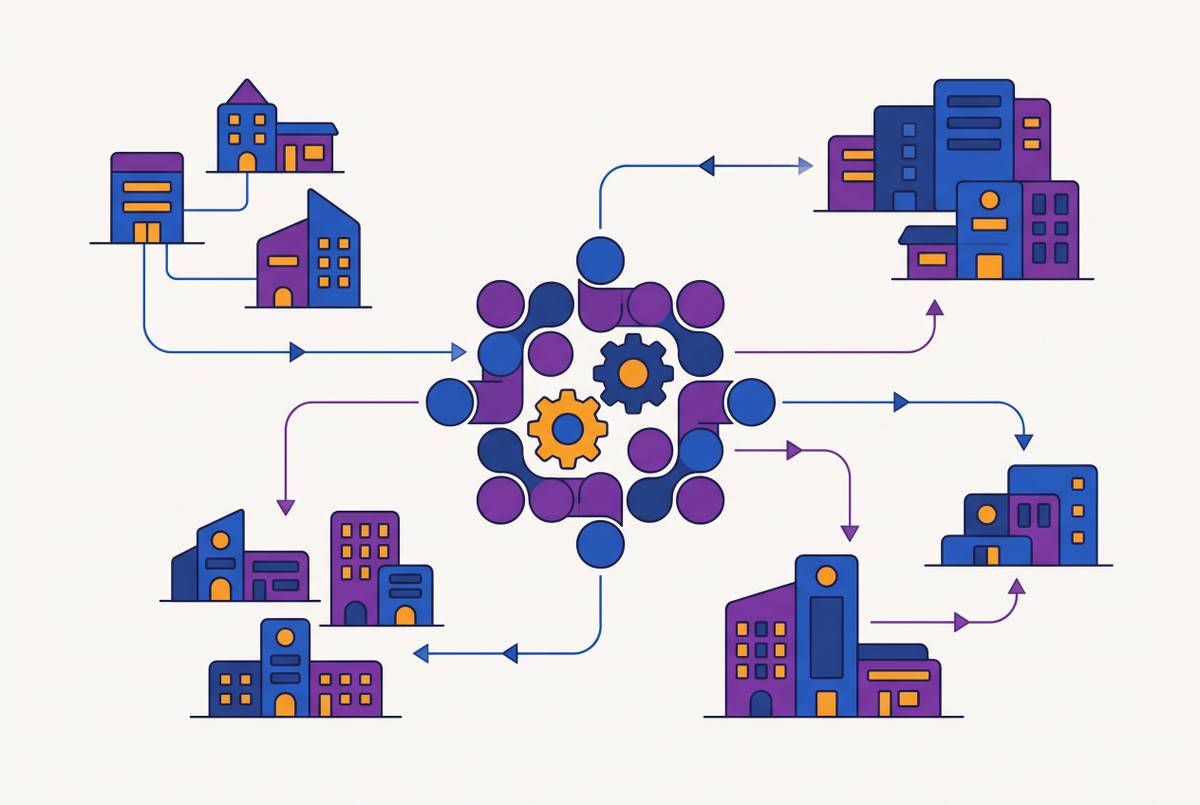
The structural cause is often a mismatch between automating a task and owning a workflow. An agent may complete one step successfully while leaving the handoff, follow-up, or unresolved case to a person. As those gaps accumulate, staff work around the agent rather than through it and eventually absorb the process back into their day. The gap between deployed and mature automation therefore reflects more than technical reliability. It also reflects whether the practice has built an operating model that keeps the full process moving.
Administrative costs consume a large share of total US healthcare spending, while revenue cycle inefficiencies drive substantial losses. Returning to manual handling restores the burden that automation was meant to reduce. A successful launch establishes that the agent can work under initial conditions.
How the underlying technology shapes whether an agent can hold up over time
How the agent is built shapes how much changes disrupt its work. Rules-based RPA repeats fixed steps, so an update to a payer portal, a new field, or a changed layout can break a sequence that worked well before. Computer-use agents instead read screens and navigate dynamically by clicking, typing, and moving through existing systems. This allows them to reach payer portals and legacy systems without requiring API connections. That reach is valuable, but it does not make every screen-operating agent equally durable.
A hybrid agent must also decide when to use visual navigation and when to call a text-level tool. Fan et al.’s 2026 hybrid agent study on the OSWorld-MCP benchmark found that the same tools improved a reasoning model but degraded a non-reasoning model by 5.9 percentage points. The non-reasoning model ignored tools, misnamed them, or falsely terminated around them. Even the reasoning model left many tool-reachable tasks on the visual route. The study calls that shortfall between available tools and their actual use the “adoption gap”.
The operational relevance of this finding about agent behavior is that access to a better route does not guarantee that an agent will choose it. An agent that ignores a suitable structured path may continue along a slower, costlier, and more brittle visual path. In a healthcare workflow, those weaknesses can become the delays and exceptions that encourage staff bypass.
What erodes first — the workflows where adoption collapses most predictably
Prior authorization exposes the weaknesses of partial automation particularly quickly. The process spans the EHR, payer portal, and clinical documentation, with work extending from documentation retrieval through submission, status tracking, and appeals. A change in any part can interrupt an agent that handled the previous version successfully. Staff already spend a large part of their week on these tasks, so a process that stops short leaves them with a lot of follow-up work. The failure mode is not simply a failed submission, but an authorization workflow that no longer advances without manual intervention.
Denial management has the same vulnerability at a different point in the revenue cycle. An agent may handle the initial claims submission but leave resubmission to staff who are short on time and resources. Without a formal denial management program, that follow-up is especially likely to be put off or left unfinished. The agent’s completed task is not the same as the practice’s completed workflow.
Scheduling and cancellation recovery make the problem less obvious because routine slots can look straightforward at deployment. An unusual patient type, an insurance edge case, or a protocol specific to a provider can still force staff to take over. Once staff get used to taking over, they may stop sending similar cases back to the agent. Across these workflows, the vulnerable points are the handoffs where systems meet and judgment becomes necessary.
Why staff behavior is the most common reason agents get bypassed after go-live
Staff bypass is better understood as a response to operational friction than as resistance to technology. An output that staff do not trust, an unclear escalation path, or a task that takes longer through the agent gives them a reason to intervene. A previous failure on an edge case can also lead them to pre-empt the agent on similar work. Each bypass reinforces the next, narrowing the agent’s effective scope without a formal change to its assigned role. Technically sound automation can consequently lose adoption when its surrounding change management is weak.
Tampa General Hospital’s ambient listening deployment for nurses illustrates this distinction. After the rollout of a tool built through Microsoft, Chief Nursing Informatics Officer Amit Patel identified operational and clinical change management, rather than the technology, as the adoption barrier requiring attention. The same distinction applies to administrative agents. Technical capability cannot by itself establish how staff should respond to uncertain output or recover from an exception. Those decisions belong to the operating model around the agent.
For administrators, the response is continuous staff engagement. Front-line staff can point out where they still have to step into a process that is supposed to be automated and where an escalation path leaves them unsure what to do. Consulting them throughout deployment helps expose these barriers before they become routine workarounds. The goal is to make the agent’s scope and escalation behavior fit the work closely enough that using it is the faster, lower-friction choice.
The operational habits that keep agents performing like reliable staff over time
The first habit is to define workflow-specific KPIs before deployment and measure them as the automation runs. Prior authorization cycle time, denial resubmission rate, and scheduling fill rate each describe an operational result. These measures establish what it means for the agent to perform like a trained staff member in its assigned role. They also provide a baseline against which deterioration becomes visible. Without that baseline, a practice may discover regression only after manual handling has returned.
The second habit is to design escalation as part of the workflow. The agent needs a defined scope for what it handles, what it flags, and who receives the flag. Staff need the same clarity so that an exception does not become an improvised handoff. Human-in-the-loop checkpoints preserve judgment where it is needed while allowing routine work to proceed autonomously. For care coordination and referrals, that design must also be closed-loop, because initiating a referral without documented confirmation does not complete the workflow.
The third habit is to monitor drift in both behavior and output quality. A payer portal change, new payer policy, or coding update can introduce friction without causing a conspicuous failure. Versioning, monitoring, and a rollback plan give the practice a way to govern these changes as production software changes. Fan et al.’s hybrid agent study found that training incentives could change how the agent routed work to tools without making it more accurate.
The fourth habit is to make the use of freed capacity visible to staff. Time released from routine execution can move toward higher-complexity work that was previously deferred or inadequately resourced. This makes the agent’s contribution concrete while giving staff a clearer role in the work that still requires judgment. Workforce planning must then go beyond the work covered by the original deployment to balance day-to-day support, efforts to keep improving the agent, and work on new workflows.
How compliance and security requirements shape what "sustained" automation actually means
Sustaining an agent that handles PHI also means sustaining its governance. Strong data encryption, signed Business Associate Agreements, access controls, and audit logging are part of the baseline for running the agent. SOC 2 Type II certification is voluntary and separate from HIPAA legal requirements. As agents reach more sensitive information across more systems, their security arrangements cannot remain a one-time go-live exercise. The requirements that govern the agent must match what it actually does.
HHS OCR has advanced proposed updates to the HIPAA Security Rule, with finalization timing still pending. The proposals call for stricter requirements for security risk analysis, encryption, access controls, and incident response. Practices therefore need to assess whether their governance model can accommodate rule changes without disrupting operations. Governance must support adaptation as well as current operation.
The CMS Interoperability and Prior Authorization Final Rule (CMS-0057-F) creates a related technical transition. It sets standard prior authorization timelines of seven calendar days and urgent timelines of 72 hours. It also requires four FHIR APIs to be live by January 1, 2027, namely Patient Access, Provider Access, Payer-to-Payer, and Prior Authorization. For practices using screen-operating agents because direct connections are unavailable, that mandate can change the routes available to complete work. Monitoring and versioning are therefore relevant to both regulatory change and technical continuity.
Interoperability remains uneven across payers and plans, so real-time prior authorization through FHIR APIs is achievable for only a subset of the market. Screen-operating agents and API-based agents will consequently coexist in most practices for the foreseeable future. Governance must cover both instead of assuming that one route replaces the other everywhere. Clear audit trails also make agent activity more defensible to payers, patients, and regulators. That accountability is part of what allows administrators and staff to rely on automation over time.
What sustained automation looks like in practices that get it right
A practice that sustains adoption organizes automation around completed workflows. Scheduling, authorization, billing, and denial appeals stay linked across the systems staff already use. Routine execution belongs to the agent within its defined scope, while staff handle the cases that require human judgment. Workflow-specific KPIs show whether that arrangement is delivering the intended result. Exceptions remain part of the governed process rather than becoming an informal route back to manual handling.
Computer-use agents are suited to enabling this operating model because they can read screens and navigate existing systems without waiting for API integration projects. Their value is that a missing connection need not limit the workflow to a single system. When structured tools become available, an agent that can route work well can use them alongside screen interaction. That architecture supports continuity, but only when monitoring, escalation, and staff engagement keep pace with its reach.
Deployment speed matters insofar as it leaves room to learn and adjust. A go-live measured in weeks rather than months can allow the practice to refine KPIs and expand scope before workarounds become entrenched. Sustained adoption nevertheless depends on treating that adaptation as an ongoing capability. The measure of success is whether, twelve months later, the agent still performs like a trained staff member on its assigned workflows, the KPIs agreed at the start are being met, and its useful scope has expanded.