Revenue Cycle Automation Vendor Shortlist for Independent Practices
Most independent practices pick the wrong vendor category before comparing the right features.

Independent practices are drowning in claims administration while the tools built to fix it sit mostly unused. An estimated 6.4 billion medical claims will move through the US healthcare system in 2026, and roughly 12% will bounce back as initial denials, each one requiring someone to investigate, correct, appeal, or write off. Only 17% of medical groups have automated more than 60% of their RCM operations, compared to roughly 74% of US hospitals that have implemented some revenue cycle automation. That gap is the real story here, and most independent practices are choosing the wrong category of tool before they ever get to comparing vendors within it.
What the four vendor categories assume about your practice
Most shortlisting mistakes happen before anyone sits through a demo. A practice manager watches three vendors show off dashboards and AI chatbots, likes two of them, and only later realizes the products solve entirely different problems. The market splits into four categories as of 2026, and each one carries a built-in assumption about what your practice already has and what it's willing to change.
All-in-one integrated suites bundle the EHR, practice management, and RCM into a single environment. They work well if a practice is ready to adopt, or already runs, the vendor's EHR. For a practice that just wants a bolt-on fix for claims, they're the wrong answer, full stop. Picking one for that reason alone is the single most expensive mistake on this list, because it drags a billing decision into a multi-year clinical systems commitment nobody asked for.
Pure-play RCM and clearinghouse platforms sit on top of whatever EHR a practice already runs, on the assumption that the clinical and billing systems are stable and the real gap sits specifically in claims submission, denial management, and payment posting. AI-native and agentic automation overlays are the newest entrants. They operate across an existing EHR, payer portals, and clearinghouse connections without demanding an API integration, on the assumption that a practice wants to keep its current stack intact while filling workflow gaps with automation. Tech-enabled outsourced RCM services go the other direction: full or partial handoff of the billing operation to a vendor that runs the technology on the practice's behalf, for practices that would rather not manage software.
Each category comes with its own implementation timeline, its own demand on staff time, its own switching cost, and its own ceiling on how deep the automation actually goes. Before any vendor gets shortlisted, a practice needs an honest answer to one question. Does it need to replace a system, layer something over what it already has, or automate one specific workflow, and does it want to run that tooling itself or hand it off? Get that question wrong, and every subsequent comparison, however careful, ends up comparing the wrong things.
What the evaluation criteria are, and which ones most practices underweight
Feature comparisons make for tidy spreadsheets. They also predict almost nothing about implementation success, which comes down to integration, workflow fit, and support, roughly in that order, and specialty fit gets skipped more often than any of the three.
Integration comes first, and the question to ask is blunt: does the vendor require API access to the EHR, or can it operate directly across the EHR, payer portals, and clearinghouses already in use? A practice should never have to rip out its EHR to get the benefit of automation. Any pitch that quietly assumes otherwise deserves more scrutiny than it usually gets.
Push further on payer connections specifically. Which ones are live today, and how are they kept current? Rule-based automation that scrapes a payer portal breaks the moment that portal's layout changes, and it takes constant manual patching just to keep working. Automation built on adaptive agents handles that drift without a rebuild, and the difference in maintenance burden compounds over a two- or three-year contract in a way most demos never reveal.
Implementation timeline and staff lift matter as much as raw capability. Practices deploying agentic overlays typically face shorter onboarding timelines than the longer, staff-intensive rollouts that come with full EHR-integrated suites. Ask directly whether onboarding requires retraining billing staff, redesigning existing workflows, or dedicating someone in-house to manage the rollout for months. A yes to all three means the vendor is selling a system, not a fix.
Workflow scope is where a lot of vendors quietly narrow their pitch mid-conversation. Automating an eligibility check is not the same as automating the full arc from claim submission through status tracking, denial response, and appeal, and vendors know the distinction blurs nicely in a slide deck. Ask exactly where the automation hands control back to a human, and why that handoff point exists there and not somewhere else. That answer says more about a product's real maturity than any accuracy statistic on a slide.
Specialty fit is the one most practices skip entirely, because they compare aggregate clean-claim rates instead of denial rates broken out by specialty. High-acuity specialties often face complex prior authorization requirements, and a generic payer rules engine isn't built for the prior authorization logic those specialties actually need. Ask for denial data cut by specialty. If a vendor can't produce it, that absence is the answer.
All-in-one integrated suites: the shortlist options and their real trade-offs for independent practices
The trade-off across this whole category is consistent: deep integration and one vendor to call when something breaks, in exchange for less flexibility to swap out individual pieces and a steep cost if the fit turns out wrong three years in.
athenahealth's athenaOne earned five Best in KLAS awards for 2026, including first place for Overall Independent Physician Practice Suite for the third year running and Practice Management for practices with 11 to 75 physicians for the fourth consecutive year. The platform runs on more than 29,000 continuously updated billing rules and connects to over 250 marketplace apps, making it a strong fit for practices that want a continuously updated billing rules engine within an integrated cloud environment. Support quality gets mixed reviews in the market, and specialty workflow depth can run thin for more complex practices. It fits best for small to mid-sized groups that want one connected cloud environment and don't want to manage rule updates themselves.
AdvancedMD expanded its Waystar-powered RCM capabilities in July 2026, adding coverage detection, denial and appeal management, paper-to-electronic EOB conversion, and analytics. The company advertises a 95% guaranteed first-pass claim rate alongside billing workflows a practice can configure fairly deeply. Initial setup is complex for new users, and satisfaction scores on review platforms are in the moderate range rather than at the top. It suits independent and ambulatory practices that want scheduling, EHR, and billing under one roof, and that are drawn to the recently expanded RCM capabilities specifically.
eClinicalWorks pairs its EHR with an integrated RCM offering designed to support ambulatory billing workflows. Its RCM offering is native to its own clinical system, meaning the two are evaluated together rather than in isolation. That makes it best evaluated as part of a broader EHR decision, not picked as a standalone billing tool. It is best evaluated as part of a broader EHR decision by ambulatory practices open to a full platform change.
Pure-play RCM platforms: when best-of-breed clearinghouse tools make sense
This category exists for a practice that already likes its EHR and has no plans to swap it, but whose actual pain sits in claims submission, denial resolution, and payment posting. Forcing a full suite migration to fix a claims problem is expensive overkill in that situation, and it's the exact mistake this category is built to prevent.
R1 RCM operates at the far end of scale, partnering with 95 of the top 100 health systems nationally and processing a substantial volume of payer transactions a year at a 97.5% average clean claim rate. It has landed Best in KLAS recognition across multiple categories for seven straight years running. None of that makes it the right fit for an independent practice. R1's model is built for hospital and health system scale, with multi-year contracts and a degree of billing control handed over that most independent groups have no interest in giving up. Treat it as the enterprise benchmark against which outsourced RCM at scale gets measured; a ten-physician group needs a different kind of shortlist candidate.
The real question for any practice evaluating this category isn't which platform has the biggest payer network on paper. It's whether denials actually stem from thin payer connectivity, or whether they're rooted in prior authorization gaps and documentation issues that no clearinghouse, however well connected, was ever built to solve. Most practices assume the former and buy accordingly. Most of the time, the second explanation is closer to true.
AI-native and agentic automation overlays: what they can and cannot do right now
This category covers tools that work over existing systems, the EHR, payer portals, the clearinghouse, the same way a staff member would sit down and click through them, without needing an API integration or a workflow overhaul to get started.
The mechanism varies by vendor. OpenAI's computer-use agent relies on vision models that interpret raw screenshots of a screen and decide what to click next. Anthropic's Claude works through a defined set of tools inside an agentic loop: reading what's on screen, clicking, typing, moving between pages in sequence. Both approaches are chasing the same target, which is what a human biller already does manually, just faster and without needing a break.
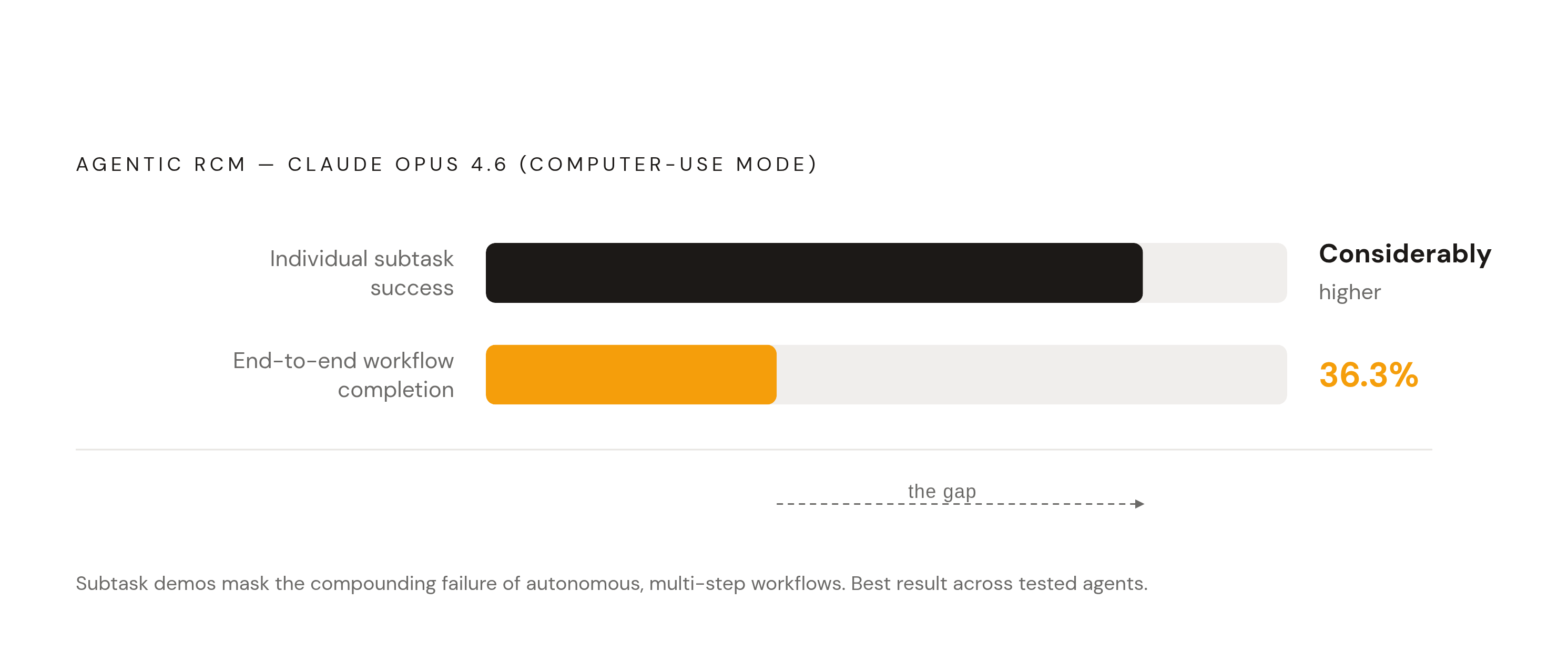
The number that should carry more weight in a purchasing decision than any vendor's marketing copy is this one. In evaluation, the strongest agent tested, Claude Opus 4.6 operating in computer-use mode, completed full end-to-end tasks only 36.3% of the time, even though its success rate on individual subtasks ran considerably higher. Full workflow completion, anything involving document handling, coordination across multiple payer portals, or tracking state over a long multi-step process, remains a genuinely hard problem. It has not been solved, whatever a sales deck implies.
That gap has a direct implication for anyone shortlisting this category. Subtask automation, checking a claim's status, pulling a remittance document, is meaningfully more mature right now than fully autonomous end-to-end completion. A practice should ask vendors to demonstrate that gap live, not in a canned recording, and should expect a human handoff point built into the workflow somewhere. A vendor claiming full autonomy across a complex revenue cycle with no exceptions is describing where the technology is headed, which is a different thing entirely, and worth pricing accordingly. It's describing where the technology is headed, which is a different thing entirely, and worth pricing accordingly.