RFP Scorecard for Healthcare AI Automation Vendors
Evaluate vendors on architecture, real-world performance, and denial prevention capability.
Vendor decks in this category all say the same three things: seamless integration, fewer denials, hours of staff time back. None of that is verifiable on its own, and none of it distinguishes a vendor whose agent survives contact with a real payer portal from one whose agent breaks the first time a dropdown menu moves. Adoption already outpaced evaluation: 86% of health systems use some form of AI, according to Notable Health's research, yet administrative bottlenecks persist across the industry. That gap is not a technology failure so much as a scoring failure. Buyers are grading vendors against security checkboxes, reference counts, and implementation timelines, none of which predict whether an agent will actually finish a prior auth on a payer's own portal at 4:45 on a Friday. What follows is a scorecard built around the questions that do predict it, organized into the domains where unstructured evaluations tend to miss the failure mode entirely.
How to score agent architecture, the foundation everything else rests on
Two architectures appear in this market, and they behave very differently once they hit a real EHR.
The first is automation that depends on APIs or integrations. It works by exchanging structured data with a system through a defined interface, and it works well right up until it hits a payer portal or an EHR screen that doesn't expose an API. At that point it simply stops. The second architecture is an agent that perceives a graphical interface visually, reading the screen, clicking the right button, and typing into the right field, the same way a trained scheduler or biller would. No API access required.
This distinction matters more in healthcare than almost anywhere else, because payer portals and legacy EHR screens are notorious for having thin or nonexistent API coverage. A purely API-dependent agent will fail at precisely the workflows that consume the most staff time, since those are usually the ones stuck behind an old browser-based portal nobody bothered to modernize. The strongest vendors build hybrid systems: visual perception paired with API connectivity where it exists, using the API as the fast path and visual navigation as the fallback when it isn't available. Pure GUI-scraping alone, with no structured fallback, tends to be brittle in its own way.
A deeper technical wrinkle underlies this, as research on these agents shows. Research on these agents, including papers on this approach published on a preprint server, points to a semantic disconnect as a core limitation: language models understand the world in terms of concepts and intent, while computer interfaces are structured as pixels, coordinates, and interface elements. Bridging that gap is what determines whether an agent can handle a five-screen prior auth workflow without losing its place. Vendors who have actually addressed this disconnect, rather than papering over it with retry logic, tend to produce agents that hold up in multi-screen, multi-system tasks.
Score this domain by asking direct questions. Does the agent navigate visually, through an API, or both, and what's the fallback logic when the primary path fails? Can it move across systems, EHR to payer portal to clearinghouse, without a human re-entering data in the middle? And when a payer portal changes its UI, which happens constantly, how fast does the agent recover: hours, days, or does it just quietly stop working until an engineer notices?
Watch for vendors who use the word "integration" without ever specifying whether it means API-based, GUI-based, or hybrid. That word alone tells you nothing about how brittle the system will be in production. This is the domain that should carry the most weight in any scorecard, because architectural limits are baked in at build time. You cannot patch your way out of a bad architecture after go-live.
Scoring for real-world performance versus benchmark claims
General-purpose agent benchmarks like OSWorld, AgentBench, and AgentGym measure something real, but not the thing a healthcare buyer needs to know. EHR screens and payer portals have their own idiosyncratic layouts, their own session timeouts, and error costs that are much higher than a benchmark task where a wrong click just means a lower score.
The OSWorld-Human research offers a useful, uncomfortable number: even the best-performing agents took several times more steps than a human expert to complete the same task. Extra steps aren't just inefficiency for its own sake. Each additional step is another chance for a misread field, another few seconds of latency, another point where a session might time out mid-task. The same study found that most end-to-end latency comes from large model calls used for planning, reflection, and judging, not from the actual clicking and typing. That's a real concern in scheduling and prior auth workflows, where a portal session that sits idle for too long simply logs itself out.
A vendor's proof of concept should look nothing like a canned demo. It should run on the buyer's actual EHR, not a sandboxed lookalike. It should show the agent completing a real prior auth submission through an actual payer portal from start to finish. It should report step count and time-to-completion measured against a trained staff member doing the same task. And it should show what happens when something goes wrong: the portal times out, a page layout shifts, a required field goes missing.
Request the vendor's documented completion rate in a healthcare GUI environment specifically, not a leaderboard ranking from a general benchmark. Ask for a recorded pilot on the buyer's own systems. Ask how step efficiency holds up as task complexity increases, because an agent that looks sharp on a three-click task can fall apart on a fifteen-click one. Any vendor whose only evidence is a general AI benchmark score, with nothing domain-specific behind it, should be treated as unproven until shown otherwise.
Scoring revenue cycle and claims automation capability
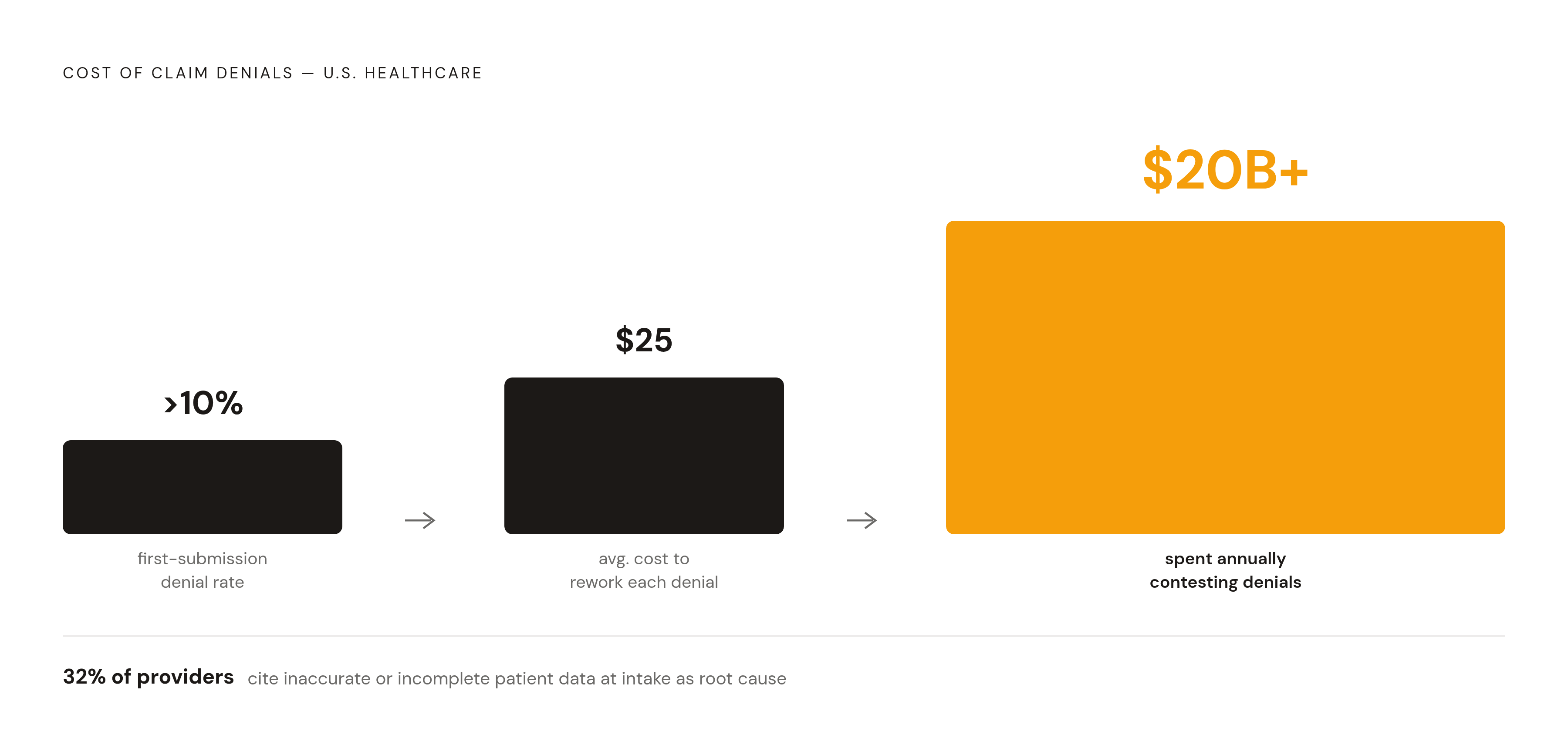
The financial stakes here are large enough that they deserve to be stated in plain terms. Industry sources tracked by Experian Health put first-submission denial rates above 10% across healthcare providers. healthcare providers, with manual rework costing an average of $25 per denied claim and health systems collectively spending more than $20 billion a year contesting denials. Experian Health's 2025 State of Claims survey adds a detail that reframes the whole problem: 54% of providers said claim errors were increasing, and 32% pointed to inaccurate or incomplete patient data at intake as a root cause. That means a vendor addressing only the appeals side of the equation, without touching intake data quality, is treating a symptom.
Strong revenue cycle automation does more than generate paperwork. It reads clinical records and extracts billing codes on its own. It submits claims directly to payers and tracks their status without someone checking a portal every few days. It predicts denial risk before a claim ever goes out and flags what's incomplete. When a denial does come back, it reads the denial letter, figures out what documentation is missing, assembles the corrected appeal, and routes it for clinical sign-off. And for prior auth specifically, it auto-updates status by reading the payer portal's own responses rather than waiting on a phone call.
OhioHealth cut denials by 42% using Experian Health's Patient Access Curator, by fixing errors at the point of intake rather than fighting them after the fact. That's the kind of documented, named outcome buyers should be asking every vendor to match, not a vague promise of "reduced denials" with no comparison point attached.
Push on specifics. What is the vendor's documented first-pass claim acceptance rate in a setting similar to the buyer's own? Does the denial workflow actually navigate the payer portal on its own, or does it stop at producing an appeal letter for a staff member to type in manually? Can the system reprioritize its own queue based on payer and denial type, rather than working through claims in the order they arrived? And what's the measured reduction in time from submission to payment in an actual deployment, not a projected one? Buyers whose biggest pain point is denials should weight this domain heavily. Buyers drowning in prior auth volume should look closely at the payer portal navigation questions specifically, since that's where the real bottleneck usually lives.
Scoring prior authorization and payer portal workflow coverage
Prior auth is the workflow that most exposes the difference between a vendor with real GUI navigation and one without it. Payer portals are inconsistent by design, updated on no predictable schedule, and thin on API coverage. This is the terrain where architecture claims either hold up or fall apart.
A vendor covering the full workflow should handle each piece: determining whether a given service even requires authorization, since that varies by payer and plan, pulling the relevant clinical documentation out of the EHR, assembling the clinical packet for submission, navigating the payer's portal to actually submit it, monitoring status and pulling decisions without a staff member checking back, and escalating to a human only when the case genuinely calls for it.
Strong implementations share a recognizable set of capabilities: dynamically prioritizing work by payer and case characteristics, automating the lookup of whether authorization is even required, automating clinical packet generation, and auto-statusing cases based on what the payer portal itself reports back. That list is a reasonable checklist to bring into a vendor demo.
Find out which payers the vendor's portal navigation actually supports, and how that list gets maintained as those portals change their interfaces, because they will. Ask whether the agent submits directly through the portal or simply prepares a packet for someone else to submit by hand, since those are very different products wearing the same label. Ask for the average time from authorization request to decision retrieval in a live account. And ask how the system handles the messy edge cases: a payer that wants more documentation, a case that needs a peer-to-peer review.
If a vendor describes its prior auth automation as "generating the letter," that's a documentation feature, not workflow automation. The step that actually saves staff time, and the step most vendors quietly skip, is portal navigation and status retrieval.
Scoring scheduling and referral intake automation depth
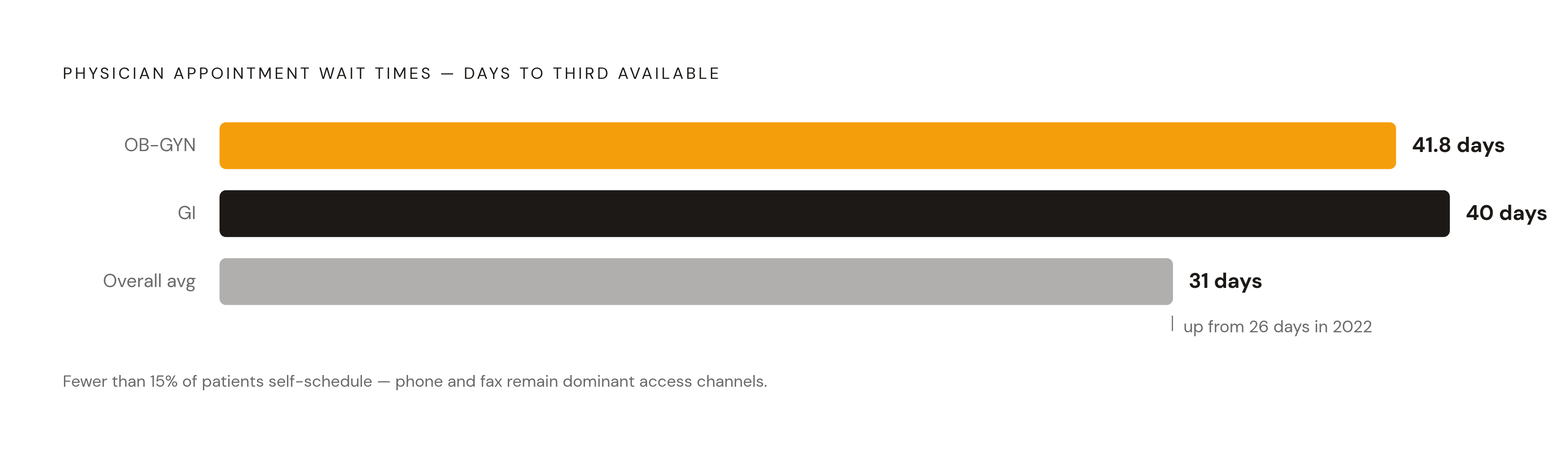
Access is a capacity problem before it's a technology problem. Prosper AI's survey data show the average physician appointment wait time reaching 31 days, up from 26 days in 2022, with OB-GYN averaging 41.8 days and GI averaging 40 days. Vendors should be scored on whether their agent actually addresses that capacity constraint, not just on how many calls it can answer. And since fewer than 15% of patients self-schedule at most groups, phone and fax remain the dominant channels an agent has to operate in, not some legacy edge case to shrug off.
Referral intake is its own capability, distinct from voice scheduling, and it's worth scoring separately. It covers ingesting faxed orders and extracting the relevant information, matching the patient to the right provider and the right slot, creating the order in the EHR without a staff member re-typing it, reaching out to the patient to confirm a self-scheduled appointment, and giving the referring provider real-time status updates instead of silence.
When evaluating vendors, throughput claims around fax transcription should be tested against documented outcomes in live accounts, not projections. That's a useful standard when a vendor makes a throughput claim of its own. On the voice side, Catholic Health's deployment of AI voice for its MyChart Helpdesk brought hold times down to near zero. Containment rate, not raw call count, is the number that actually tells a buyer something. Containment rate, not raw call count, is the number that actually tells a buyer something.
Ask whether the vendor's agent covers the full path from fax to scheduled appointment or just one link in that chain, like outbound reminder calls. For voice specifically, ask for the documented containment rate in a live account and how escalation to a human actually works when the agent hits its limit. Ask whether it can proactively fill cancellation slots from a waitlist or only reacts to inbound requests. And ask whether it writes the appointment into the EHR directly or hands that last step back to staff, which quietly reintroduces the labor the vendor claimed to remove. Voice AI answering inbound calls is one narrow slice of this problem. A complete scheduling agent covers referral intake, cancellation recovery, and provider utilization together, and vendors should be scored on that whole picture rather than whatever feature looks best in the demo.
Scoring deployment speed, integration model, and what "go-live" means
The integration model a vendor chooses quietly determines most of the hidden cost of deployment. API-dependent systems require IT involvement, cooperation from the EHR vendor, and often months of integration work before a single workflow goes live. Computer-using agents that log in with a staff credential and operate the existing interface skip most of that; deployment timelines compress down to weeks rather than quarters, because there's no integration project to schedule in the first place.
Notable Health's research found 72% of executives naming automation and AI as their top RCM investment priority for the coming year. That level of urgency is exactly why deployment timeline deserves real weight in a scorecard, not treatment as an afterthought behind feature comparisons.
Score the integration model itself: API-dependent, GUI-based, or hybrid, and what that implies for the IT hours and EHR vendor cooperation required. Push for a real time-to-first-live-workflow, measured in weeks, ideally as a contractual milestone rather than a marketing phrase like "rapid deployment." Ask whether staff have to change how they currently work to accommodate the system, or whether the agent slots in alongside existing processes. And ask how new workflows actually get built once the first one is live: manual development work every time, some no-code configuration tool, or an AI-assisted engine, and who owns the upkeep once it's running.
Cost estimates from AleaIT Solutions put healthcare AI development anywhere from roughly $40,000 for basic tools up past $1 million for enterprise platforms with generative AI, multi-system integration, and compliance work baked in. That range is wide enough to be nearly meaningless on its own, so buyers should push vendors to map pricing to the specific workflows actually in scope, not a generic platform tier.
Press the vendor on what "go-live" means to it: an agent running in a sandbox somewhere, or one processing live patient workflows without a human minding it. Ask what IT resources and EHR vendor involvement are required before that first workflow runs for real. Ask how long recovery takes when a payer portal changes its UI or the EHR pushes an update, and who is on the hook for fixing it. And for any multi-location group, ask how a workflow scales from one site to a whole portfolio without being rebuilt from scratch each time. A vendor who talks about "seamless integration" without saying whether that requires EHR API access isn't describing a deployment model. They're describing a hope.
Scoring HIPAA compliance and PHI security as operational requirements, not differentiators
Computer-using agents touch protected health information at every stage of the workflows covered in this scorecard, scheduling, prior auth, claims, all of it. That makes security architecture a condition of operating at all, not a compliance checkbox to satisfy once and forget.
Certain baseline requirements should disqualify a vendor before any scoring even begins. A Business Associate Agreement under HIPAA needs to be in place before any PHI touches the vendor's system, full stop, with no exceptions carved out for pilots or trial periods. Beyond the BAA itself, buyers should expect clear answers on how PHI is encrypted in transit and at rest, how access is logged and audited, how credentials the agent uses to log into EHRs and payer portals are stored and rotated, and where, geographically and infrastructurally, the data actually lives while the agent is working with it.
None of this differentiates a good vendor from a great one. It differentiates a vendor a buyer can legally work with from one they cannot. Treat it that way in the scorecard: not as a point of comparison to weigh against features, but as a gate a vendor either clears or doesn't before the rest of the evaluation even starts.