Payer Portal Access Security Risks in Automated Workflows
Screen-operating agents holding portal credentials create security exposures human logins never do.
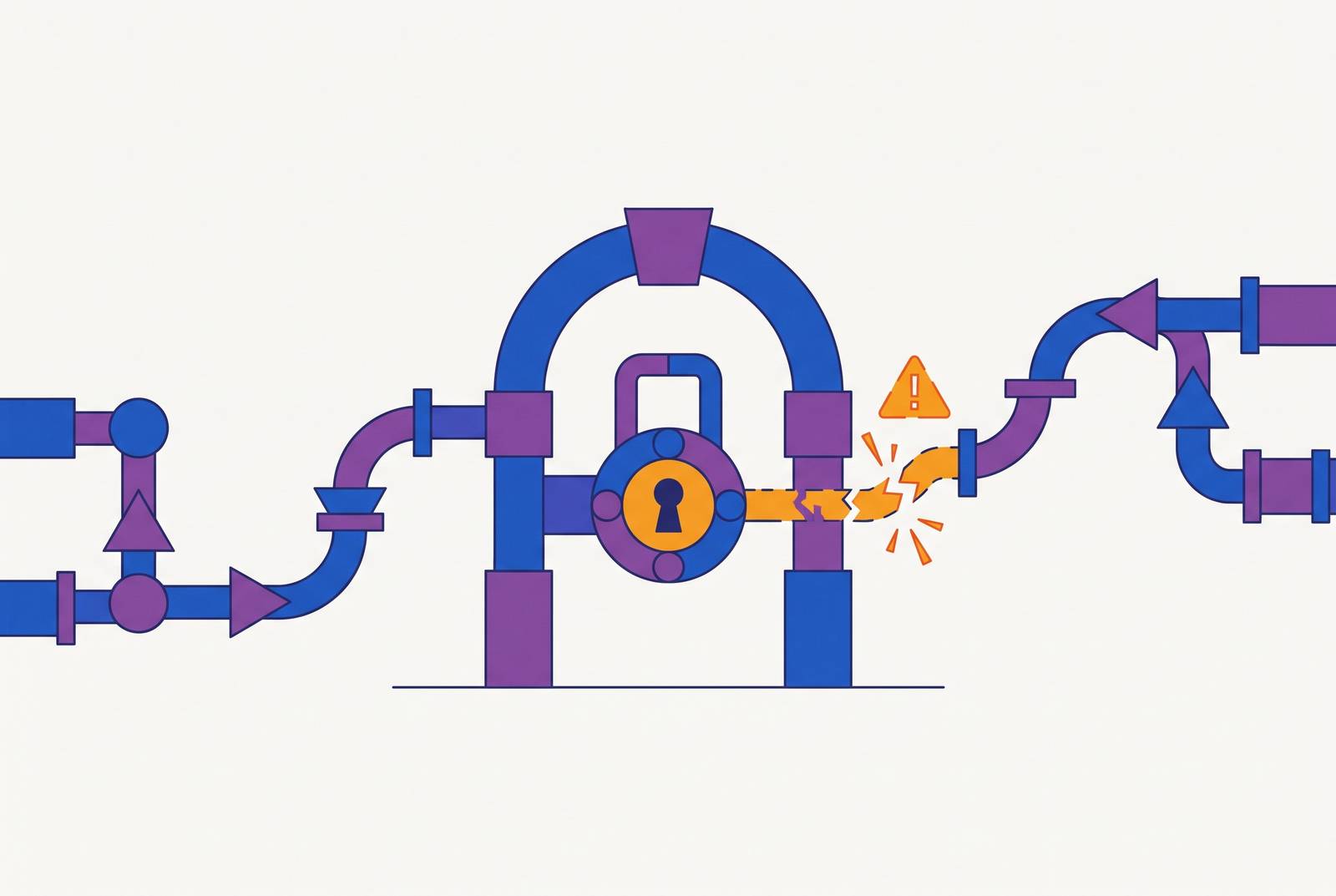
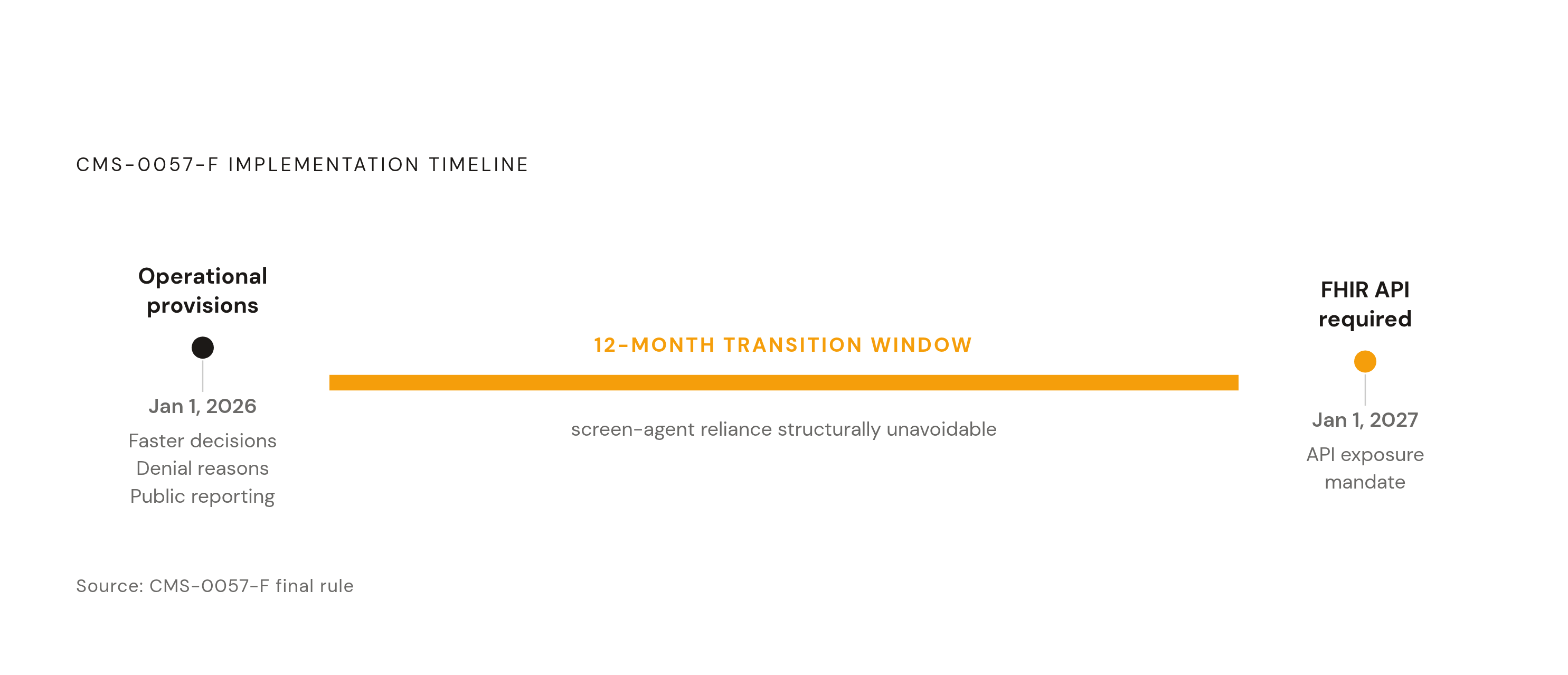
Payer portal automation runs on screen-operating agents because a substantial share of payer portal interactions lack clean API access, leaving vendors no cleaner way to automate prior authorization, claim status checks, and denial work. An agent built for this job has to navigate visually: it logs in, reads the screen, clicks the right button, and fills the form, performing each step the way a human staff member would. Modern payer portals compound the problem with multi-factor authentication flows, session tokens, CAPTCHA challenges, and dynamic JavaScript rendering, all of which rule out simpler scraping tools and leave a true screen-operating agent with visual recognition as the practical workaround. The CMS Prior Authorization API, finalized under CMS-0057-F, does not require payers to expose a FHIR API until January 1, 2027, even though the rule's operational provisions, including faster decision timeframes, specific denial reasons, and public reporting, took effect January 1, 2026. That gap between operational obligation and technical interface leaves a transition window in which screen-agent reliance is the only viable bridge for payers that remain portal-only, and it is a structural feature of the payer landscape rather than a shortfall vendors will engineer away soon. Practices planning automation today are planning around an agent that must hold real credentials and maintain an authenticated session to do its job, and that single fact puts the security surface in a different category from a system that merely reads an API response.
Authenticated screen-agent sessions versus human logins
An agent holding an authenticated payer portal session is an autonomous system with delegated identity and persistent access, and it can act at machine speed across several workflows at once. A human session ends when the employee closes the browser window, but an agent session may be long-lived or automatically renewed, which keeps access open between task cycles in a way no human login pattern does. Research on autonomous AI execution published under the name PARALLAX frames the shift precisely: once a large language model is embedded in an agent with execution privileges, a safety failure can produce data exfiltration, credential theft, or system compromise, outcomes categorically different from a generative model simply producing a wrong answer.
Agents also tend to inherit permissions from service accounts or delegated user access, and those permissions accumulate over time, so a deployment that starts narrowly scoped can evolve into a highly privileged identity with reach across multiple portal environments. ARMO's 2026 analysis of AI agent security in financial services draws the contrast sharply: traditional software workloads are deterministic, making the same calls and following the same paths every time, while AI agents execute generated code, traverse permissions dynamically, and behave differently with every interaction. That assumption is the root of most existing governance policy, which assumes one set of rules can cover every case because the system's behavior is predictable, and the mismatch is what breaks down here. An agent operating inside a payer portal also holds more context simultaneously than any single human employee would: authenticated sessions, patient insurance records, clinical documentation queues, and prior authorization histories can all be in scope for the same task. Each of the risks that follow, credential handling, session persistence, prompt injection, and PHI exposure, grows out of this basic structural fact: the agent's session is not a login, it is a standing capability.
The credential handling problem HIPAA's Technical Safeguards already address
Shared credentials, the default pattern in most agent deployments, violate HIPAA's unique user identification requirement directly and collapse audit accountability at the exact layer where PHI access takes place. HIPAA's Technical Safeguards at § 164.312(a)(2)(i) require that each user of an information system be assigned a unique name or identifier. When agents operate under a shared service account or a shared API key, every ePHI access event attributes back to a single identifier, so you cannot reconstruct individual accountability after the fact.
MiniOrange's 2026 enterprise AI security analysis names static or hardcoded credentials as one of the six biggest AI agent security risks of the year: long-lived API keys, shared service accounts, and secrets embedded in configuration files are simple to set up and hard to manage once an organization is running more than a handful of agents. Credentials in these deployments are rarely rotated, several agents often reuse the same token, and no one holds clear responsibility for the credential's lifecycle from issuance to retirement. When an auditor asks which agent accessed a given patient record and who authorized that access, a shared credential supplies no answer, because the audit trail stops at the account name.
The control is not complicated to describe, even if it takes discipline to implement: each agent should carry a unique identity and credential, secrets belong in a dedicated vault rather than a configuration file, and short-lived tokens should replace permanent API keys. Done properly, this makes it possible to trace any portal access event to a specific agent, and through that agent, to the workflow and the human authorizer who stands behind it. Vendors frequently point out that their platforms already issue a unique API token per agent instance, and that claim is often true. It matters only if those tokens are also rotated, scoped to the minimum access the task actually requires, and logged. A unique token with permanent, broad scope is a modest improvement over a shared key, but it leaves most of the underlying exposure in place.
Session management risk: what happens between the login and the logout
Human portal sessions are bounded by attention and fatigue: they end when an employee closes the browser window and walks away. Agent sessions carry no such natural limit. You can hold them open indefinitely, renew them automatically, or reuse them silently across multiple patient records and workflows, so the window of potential unauthorized access stretches far beyond anything a human workflow would tolerate. In a payer portal context, over-privilege has a concrete shape: an agent authorized only to check claim status may still technically be able to pull a patient's full history, download clinical documentation, or initiate a submission the workflow never intended it to make.
Least-privilege session design is the architectural answer. Agents should request scoped, time-limited sessions tied to each individual workflow execution, those sessions should terminate the moment the task completes, and agents should be barred from holding persistent portal access between execution cycles. Applied to a payer portal, least privilege means defining permissions at the level of the actual task, prior authorization submission, claim status check, or denial appeal, rather than issuing one broad account credential that covers every task an agent might ever perform. The risk here is architectural permissiveness: a system built to allow more than any given task needs, sitting open longer than any given task requires. What happens when that permissiveness is deliberately exploited by an outside actor is a separate question, and it is the subject of the next risk.
Prompt injection: the attack vector that turns portal access into a data exfiltration path
Prompt injection is the attack native to agentic AI, and it is especially dangerous in payer portal workflows because the agent already holds everything an attacker would want: an authenticated session, access to PHI, and the capacity to act on both at machine speed. Salt Security's 2026 framework distinguishes indirect prompt injection as the more dangerous variant. Malicious instructions get hidden inside content the agent retrieves during ordinary operation, emails, documents, support tickets, web pages, or knowledge base articles, rather than delivered through a direct adversarial exchange with the agent itself.
PARALLAX makes the underlying structural argument: prompt guardrails share the same computational substrate as the threats they are meant to stop. The model processes a safety instruction and a piece of adversarial input through the identical mechanism, with no architectural line separating trusted instructions from untrusted data. That absence of a boundary makes injection possible. Applied to a payer portal, the attack path looks like this: an instruction buried inside a payer denial letter or a portal notification tells the agent to call a bulk data export function that its service account already permits. The agent follows that instruction through what looks like a legitimate action path, and in a shared-credential audit log, the entire event is indistinguishable from normal operation.
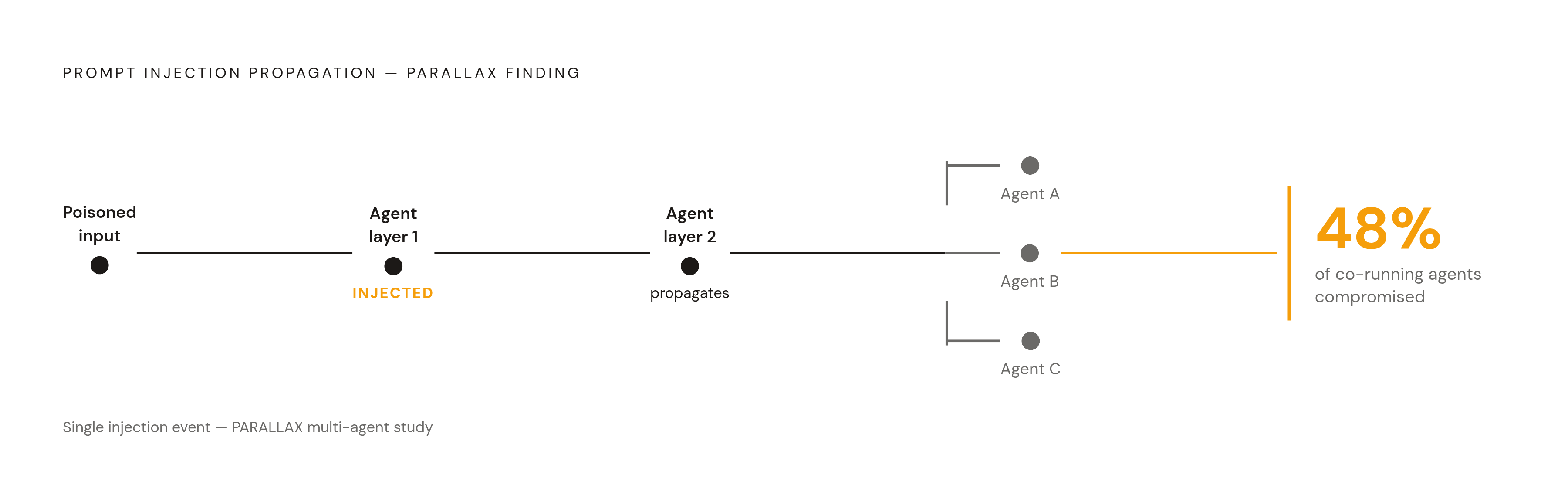
ARMO's 2026 analysis offers the closest sourced parallel, drawn from financial services rather than healthcare: a compromised agent with transaction system access, acting on a prompt injection embedded in a support ticket, calls a bulk data export tool its service account technically permits and begins exfiltrating records through what appears to be a routine API path. The attack unfolds in moments. In multi-agent systems, where one agent's output becomes the next agent's input, PARALLAX's research shows that a successful injection at one layer propagates forward through subsequent layers, and it affected 48% of co-running agents in a multi-agent system during a single injection incident. None of this is a future hypothetical: the same research documents injection attempts against enterprise AI systems rising sharply in late 2025, with indirect attacks now making up the majority of observed cases. PARALLAX's proposed fix is structural rather than linguistic: separate the agent's reasoning process from its execution capability, so that a compromised reasoning layer cannot issue a portal action directly and must instead pass through an independent validation layer before anything executes. Prompt-level guardrails alone cannot provide that separation, because they operate inside the very system an attacker has already compromised.
PHI exposure at the point of screen interaction
Every screen interaction inside a payer portal workflow exposes PHI, and absent deliberate controls on what the agent reads, stores, and transmits, ordinary operation creates PHI exposure with no attack required to produce it. A screen-operating agent reads what a human staff member would read in the same seat: patient name, member ID, diagnosis codes, procedure codes, clinical notes attached to a prior authorization request, and the payer's denial rationale. All of it is on-screen PHI, and the agent processes it to complete whatever task it was sent to do.
HIPAA's minimum necessary standard requires covered entities to make reasonable efforts to limit PHI access to what a given task actually requires. An agent that reads a patient's full record to extract a single claim status fails that standard even if it retains nothing afterward, because most portal workflows are not scoped at the field level. Salt Security's analysis treats data exfiltration through agent outputs as a risk distinct from adversarial attack: an agent answering a perfectly normal workflow request can reveal information from a system the person making the request did not know the agent could reach. The exposure happens through ordinary output, with no malicious intent anywhere in the chain.
Memory and context retention make the problem worse. Agents built with persistent conversation memory can carry PHI from one patient's workflow into the context window of the next patient's task, and broad context retention is one of the most common ways agents violate minimum necessary once they are running in production. The corresponding control has three parts: agents should read only the fields a task requires, clear PHI from working memory once the task is complete, and avoid logging full portal screen content into general-purpose audit systems where it becomes reachable well beyond the task's original authorization scope. None of this reflects a failure in the automation concept itself. It reflects a scoping and design discipline that has to be built in.
Audit trail integrity: what regulators will ask for
A HIPAA audit of payer portal access poses a specific set of questions: which user or system accessed which patient record, at what time, for what purpose, and under whose authorization. Shared credentials cannot answer those questions. Neither can persistent sessions, nor screen-reading agents that log only task outcomes, such as "task completed," without logging the PHI the agent actually traversed to get there.
A proposed 2025 amendment to the HIPAA Security Rule would require covered entities to maintain a written inventory of AI systems that create, receive, maintain, or transmit ePHI. Under that framework, a risk analysis completed before an organization deployed its current AI systems counts as an audit finding on its own, independent of whether any breach has occurred. Crest Data's 2026 analysis of secure workflow automation identifies where the industry is heading in response: security and auditable controls built into every stage of an automated workflow, policy-as-code enforcement, and continuous compliance automation that logs every automation activity and maps it to a regulatory framework, with any breach of security policy triggering an automatic flag or halt.
In practice, that means agent-level logging has to capture more than most current deployments capture: which agent instance executed which action, the specific portal screens and fields it accessed, the patient record involved, the timestamp, the workflow that authorized the action, and the human operator, if one reviewed or approved it. The gap most organizations face is structural. Production agent deployments typically log at the workflow level, recording that a task was submitted and that it was completed, rather than at the interaction level, recording which field was read, which screen was traversed, and which session token was used to do it. Interaction-level logging has to be designed in at deployment. Retrofitting it onto a system already running in production is far harder, and far more expensive, than building it in from the start.